Country charts, insights, and microdemographic fertility indicators
Snapshot
What Share of Women Become Mothers? (1/7)
How Many Children Do Mothers Have? (2/7)
At What Age Do Women Become Mothers? (3/7)
What Share of Mothers Have Exactly One Child? (4/7)
What Share of Mothers Have Exactly Two Children? (5/7)
What Share of Mothers Have Three or More Children? (6/7)
What Share of Women Remain Childless for Life? (7/7)
How Low Are Overall Births? (1/6)
What is the Future Trajectory? (2/6)
How Many Babies Are Born Each Year? (3/6)
How Do Births Compare to Future Retirees? (4/6)
How Fast Does One Generation Become Smaller? (5/6)
Where to Go Next (5/6)
 United States
(1970–2024)
United States
(1970–2024)
2024 Snapshot
Key Trends
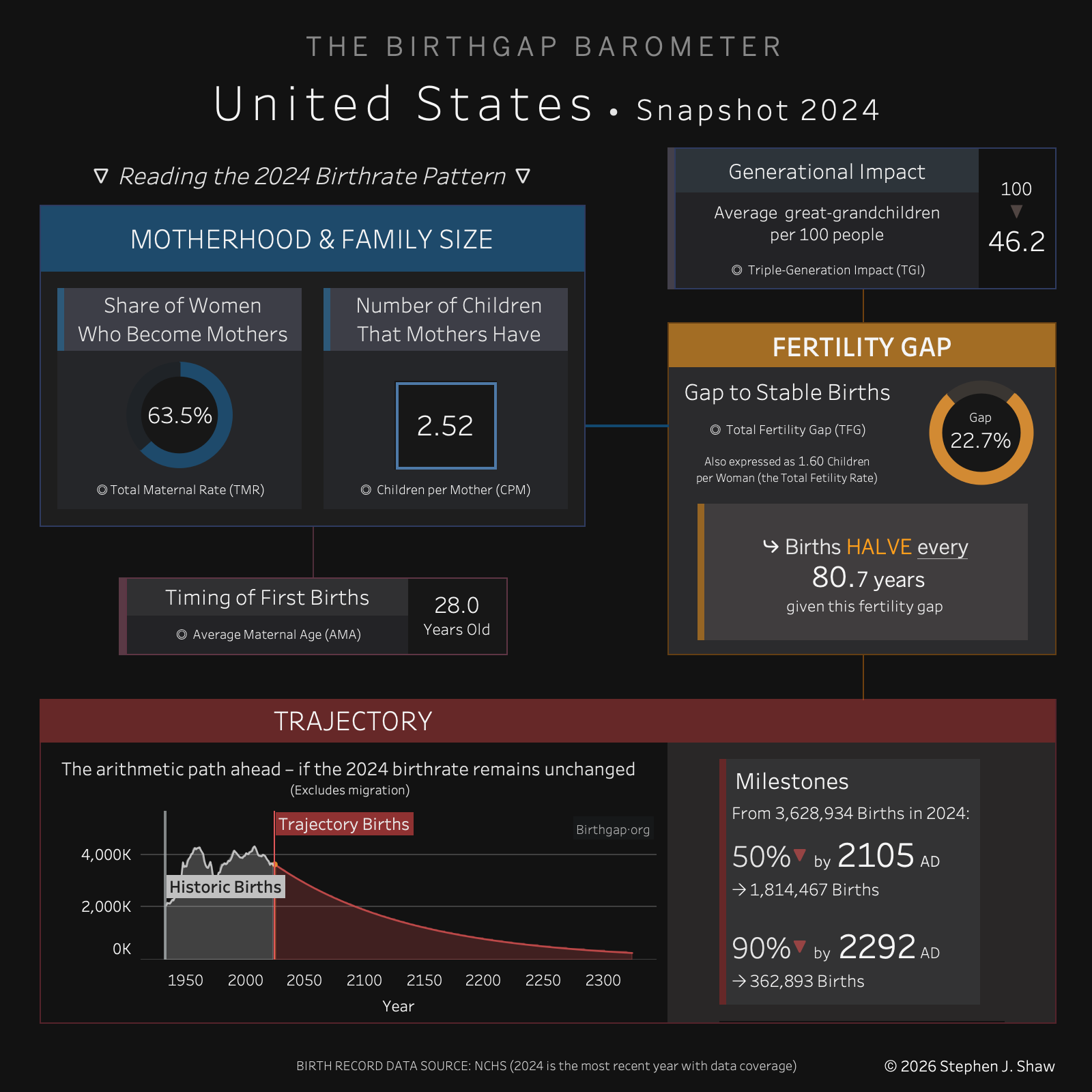
In 2024, maternal and fertility rates in the United States show slight declines and generally low rankings despite minor increases in some birth figures.
- Total maternal rate slightly declined, ranking 20th globally
- Children per mother highest globally at 2.52
- Mean maternal age is low, ranked 34th out of 38
- Lifetime childlessness rate rising, mid-ranked at 19th
- Societal Half-Life remains one of the longest, ranked 3rd globally
What Share of Women Become Mothers?(1/7)
Motherhood prevalence slightly declined but generally rising over five years.
- 63.5% become mothers in 2024
- Down 0.5 points from the prior year
How Many Children Do Mothers Have?(2/7)
Average children per mother continues a slow decrease.
- Mothers average 2.52 children in 2024
- Down 0.01 from the prior year
At What Age Do Women Become Mothers?(3/7)
Average maternal age is increasing, nearing 28 years.
- Average first-birth age is 28.0 in 2024
- Up 0.1 years from the prior year
What Share of Mothers Have Exactly One Child?(4/7)
Proportion of one-child mothers is on the rise.
- 19.8% of mothers have one child in 2023
- Up 2.4 points from the prior year
What Share of Mothers Have Exactly Two Children?(5/7)
Two-child motherhood is experiencing a modest decline.
- 38.2% of mothers have two children in 2023
- Down 0.9 points from the prior year
What Share of Mothers Have Three or More Children?(6/7)
Mothers with three or more children are decreasing.
- 42.0% of mothers have three or more in 2023
- Down 1.5 points from the prior year
What Share of Women Remain Childless for Life?(7/7)
Childlessness rate is decreasing gradually over recent years.
- 36.5% remain childless in 2024
- Up 0.5 points from the prior year
How Low Are Overall Births?(1/6)
Birthgap generational indicator shows a small rising trend.
- The birthgap stands at 22.7% in 2024
- Up 1.0 points from the prior year
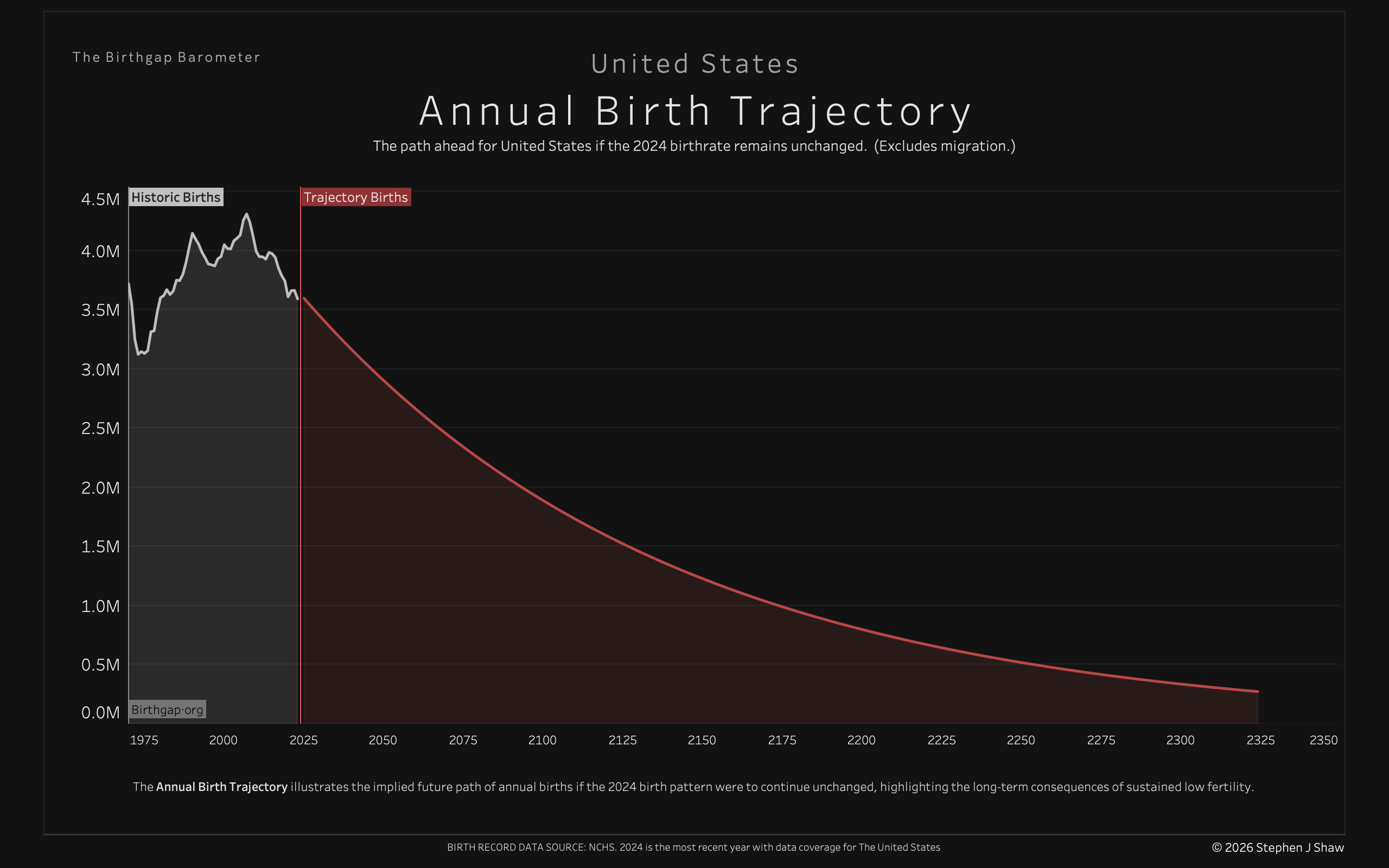
What is the Future Trajectory?(2/6)
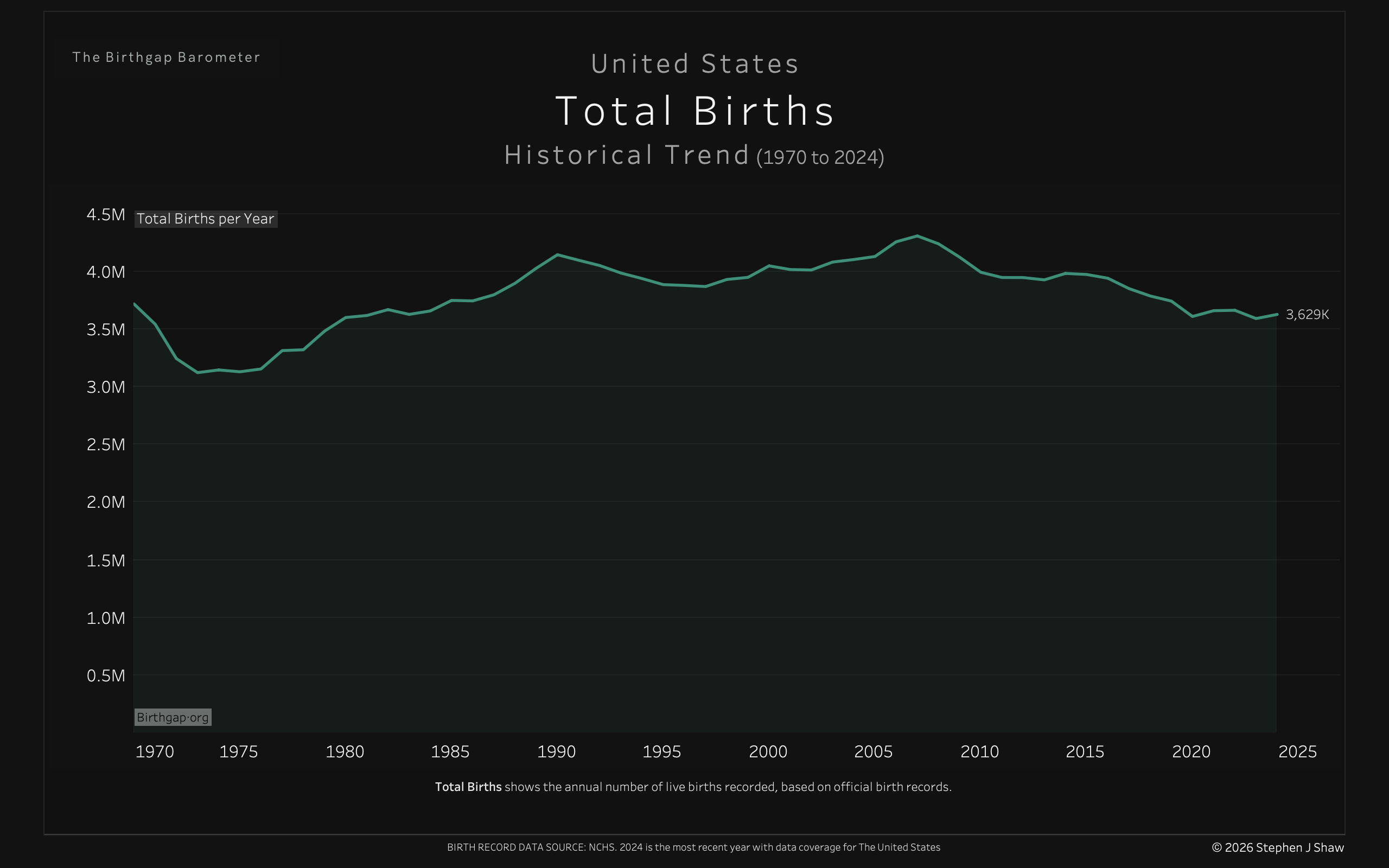
How Many Babies Are Born Each Year?(3/6)
Total births are increasing slightly in the latest year.
- 3,628,934 births were recorded in 2024
- Up 35,900 from the prior year
How Do Births Compare to Future Retirees?(4/6)
Birthgap retirement indicator has decreased significantly recently.
- The retiree birthgap stands at 6.9% in 2024
- Down 3.6 points from the prior year
How Fast Does One Generation Become Smaller?(5/6)
Where to Go Next(6/6)
For more detailed information, read the full Birthgap Country Report for United States.
Read the Report →
 Canada
(1970–2024)
Canada
(1970–2024)
2024 Snapshot
Key Trends
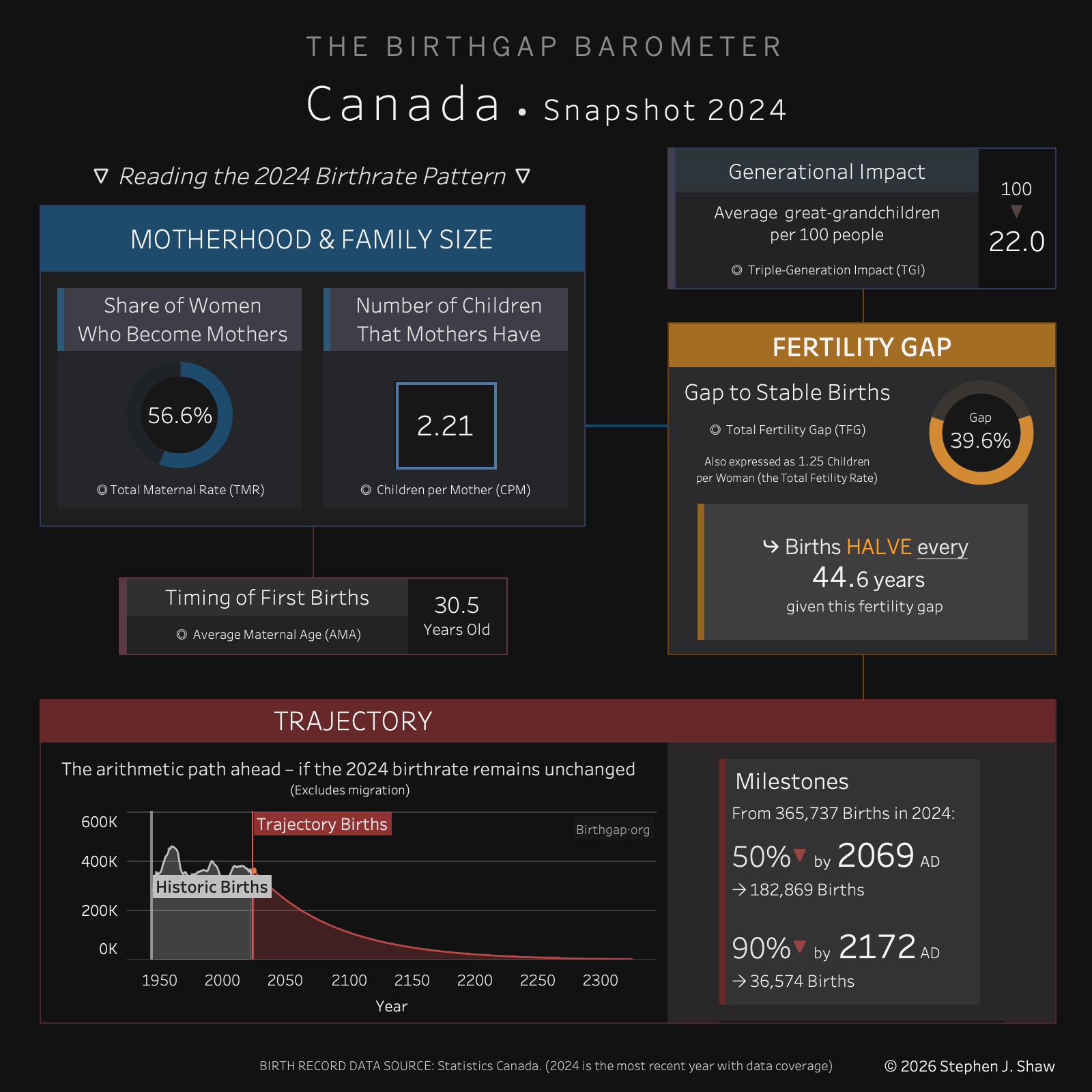
In 2024, Canada shows a stable but declining fertility rate with increasing maternal age and high childlessness continuing long-term trends.
- Total maternal rate (56.6%) below global average, ranked 29/38 countries
- Average maternal age oldest in 13/38 countries at 30.5 years
- Lifetime childlessness high at 43.4%, ranking 10th globally
- Birthgap indicator remains large, consistently above 35%, ranked 12th worldwide
- Low birthrate index places Canada near the lowest globally, ranked 32/35
What Share of Women Become Mothers?(1/7)
Motherhood prevalence slightly declines, continuing a five-year downward trend.
- 56.6% become mothers in 2024
- Down 0.2 points from the prior year
How Many Children Do Mothers Have?(2/7)
Average children per mother drops slightly, following recent decreases.
- Mothers average 2.21 children in 2024
- Down 0.01 from the prior year
At What Age Do Women Become Mothers?(3/7)
Average maternal age rises steadily, now exceeding 30 years.
- Average first-birth age is 30.5 in 2024
- Up 0.2 years from the prior year
What Share of Mothers Have Exactly One Child?(4/7)
One-child motherhood increases notably over the past five years.
- 25.1% of mothers have one child in 2023
- Up 3.7 points from the prior year
What Share of Mothers Have Exactly Two Children?(5/7)
Two-child motherhood declines, reversing previous stability.
- 46.0% of mothers have two children in 2023
- Down 1.5 points from the prior year
What Share of Mothers Have Three or More Children?(6/7)
Three-plus-child motherhood continues a gradual downward trend.
- 28.9% of mothers have three or more in 2023
- Down 2.2 points from the prior year
What Share of Women Remain Childless for Life?(7/7)
Childlessness rate edges up, continuing a gradual rise over five years.
- 43.4% remain childless in 2024
- Up 0.2 points from the prior year
How Low Are Overall Births?(1/6)
Birthgap Generational Indicator shows a modest recent increase.
- The birthgap stands at 39.6% in 2024
- Up 0.3 points from the prior year
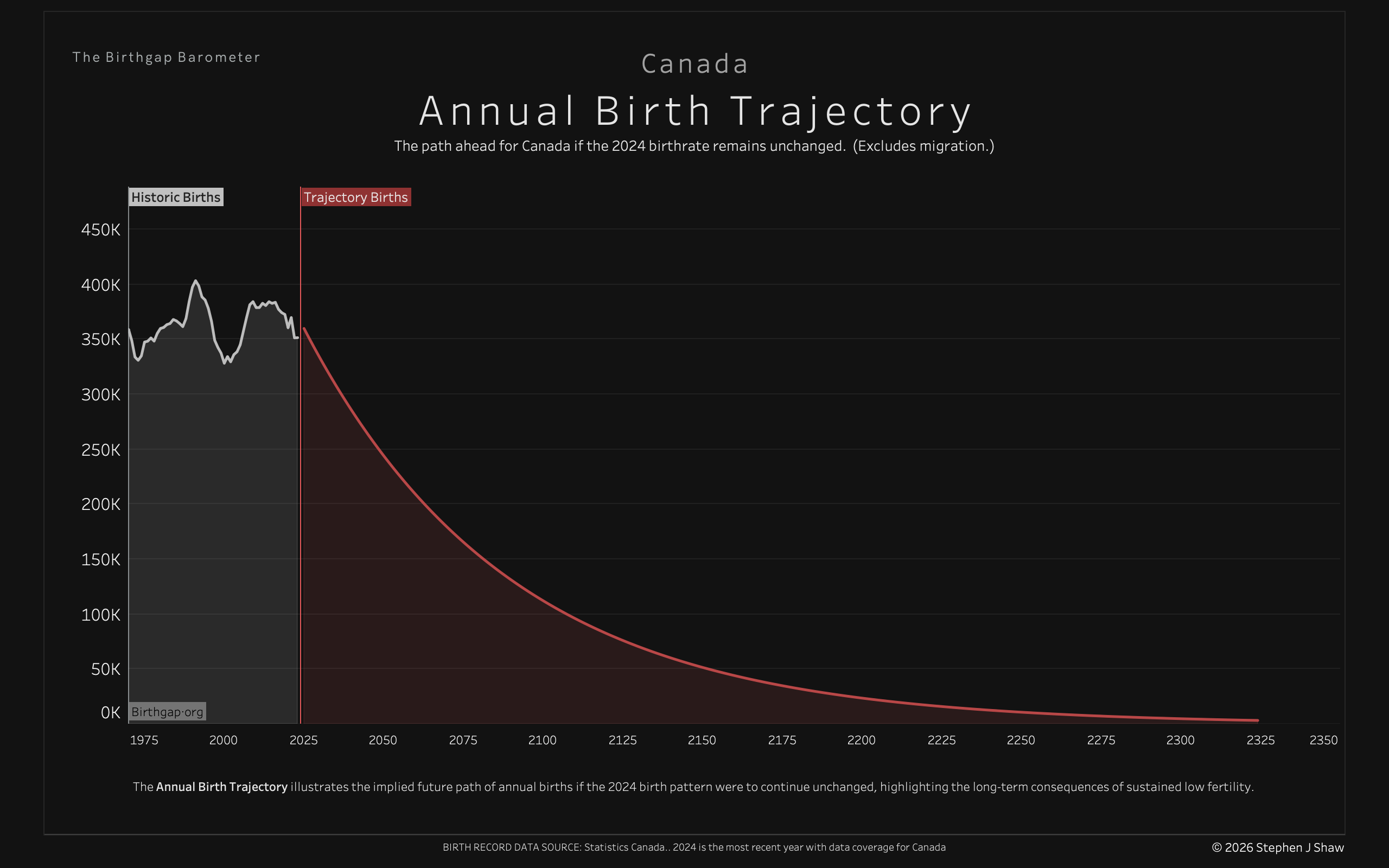
What is the Future Trajectory?(2/6)
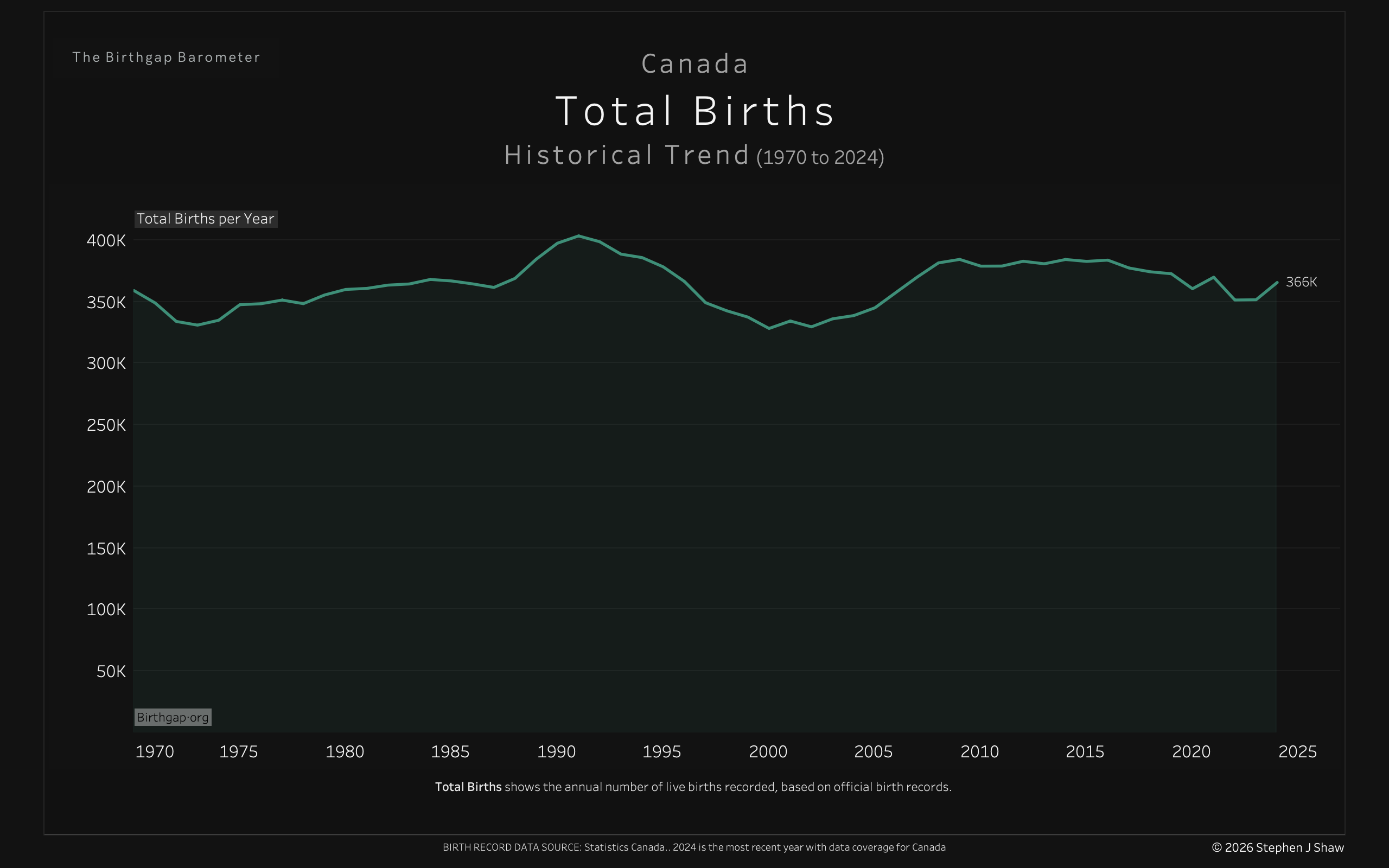
How Many Babies Are Born Each Year?(3/6)
Total births rise moderately, indicating a recent fertility increase.
- 365,737 births were recorded in 2024
- Up 14,022 from the prior year
How Do Births Compare to Future Retirees?(4/6)
Birthgap Retirement Indicator falls, reflecting changing generational patterns.
- The retiree birthgap stands at 23.7% in 2024
- Down 2.4 points from the prior year
How Fast Does One Generation Become Smaller?(5/6)
Where to Go Next(6/6)
For more detailed information, read the full Birthgap Country Report for Canada.
Read the Report →
 Japan
(1970–2024)
Japan
(1970–2024)
2024 Snapshot
Key Trends
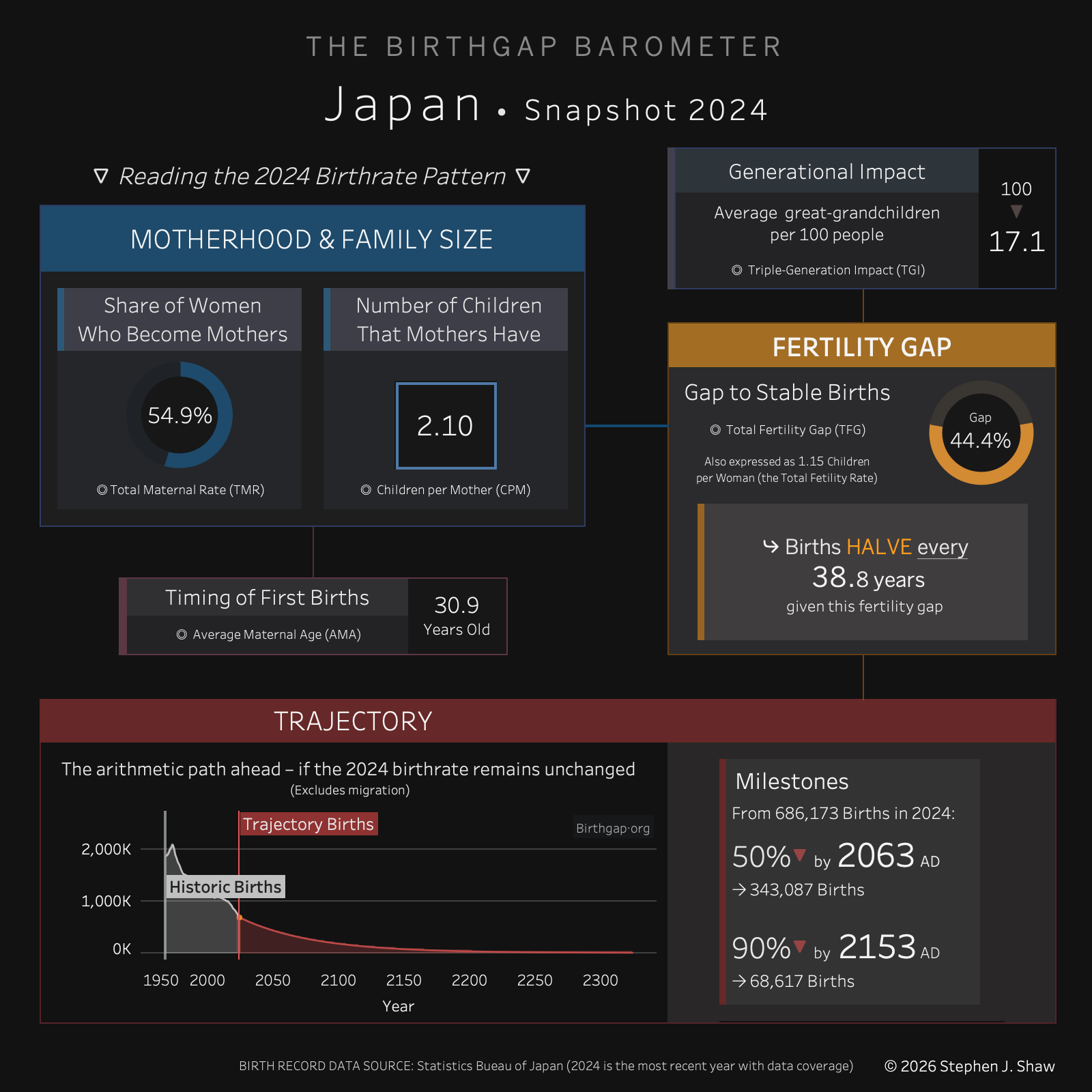
In 2024, Japan shows a continuation of long-term demographic shifts including low fertility, rising childlessness, and increasing maternal age.
- Total maternal rate among lowest globally, ranked 32/38 countries
- Children per mother stable near global average, ranked 17/38
- Average maternal age rising, ranked 11/38 globally
- High childlessness rate and generational birthgap, ranked 7/38 globally
- Strong birth rate increase relative to past, ranked 2/35 globally
What Share of Women Become Mothers?(1/7)
Motherhood prevalence is slightly declining in recent years.
- 54.9% become mothers in 2024
- Down 1.7 points from the prior year
How Many Children Do Mothers Have?(2/7)
Children per mother remains stable near two children.
- Mothers average 2.10 children in 2024
- Down 0.02 from the prior year
At What Age Do Women Become Mothers?(3/7)
Average maternal age continues to rise, now nearly 31 years.
- Average first-birth age is 30.9 in 2024
- Up 0.2 years from the prior year
What Share of Mothers Have Exactly One Child?(4/7)
Proportion of one-child mothers is slowly rising.
- 21.4% of mothers have one child in 2023
- Up 0.6 points from the prior year
What Share of Mothers Have Exactly Two Children?(5/7)
Two-child motherhood is trending upward recently.
- 51.4% of mothers have two children in 2023
- Up 0.7 points from the prior year
What Share of Mothers Have Three or More Children?(6/7)
Mothers having three or more children are decreasing.
- 27.2% of mothers have three or more in 2023
- Down 1.3 points from the prior year
What Share of Women Remain Childless for Life?(7/7)
Childlessness rate is gradually increasing over the past five years.
- 45.1% remain childless in 2024
- Up 1.7 points from the prior year
How Low Are Overall Births?(1/6)
Birthgap generational indicator shows a steady increase.
- The birthgap stands at 44.4% in 2024
- Up 2.2 points from the prior year
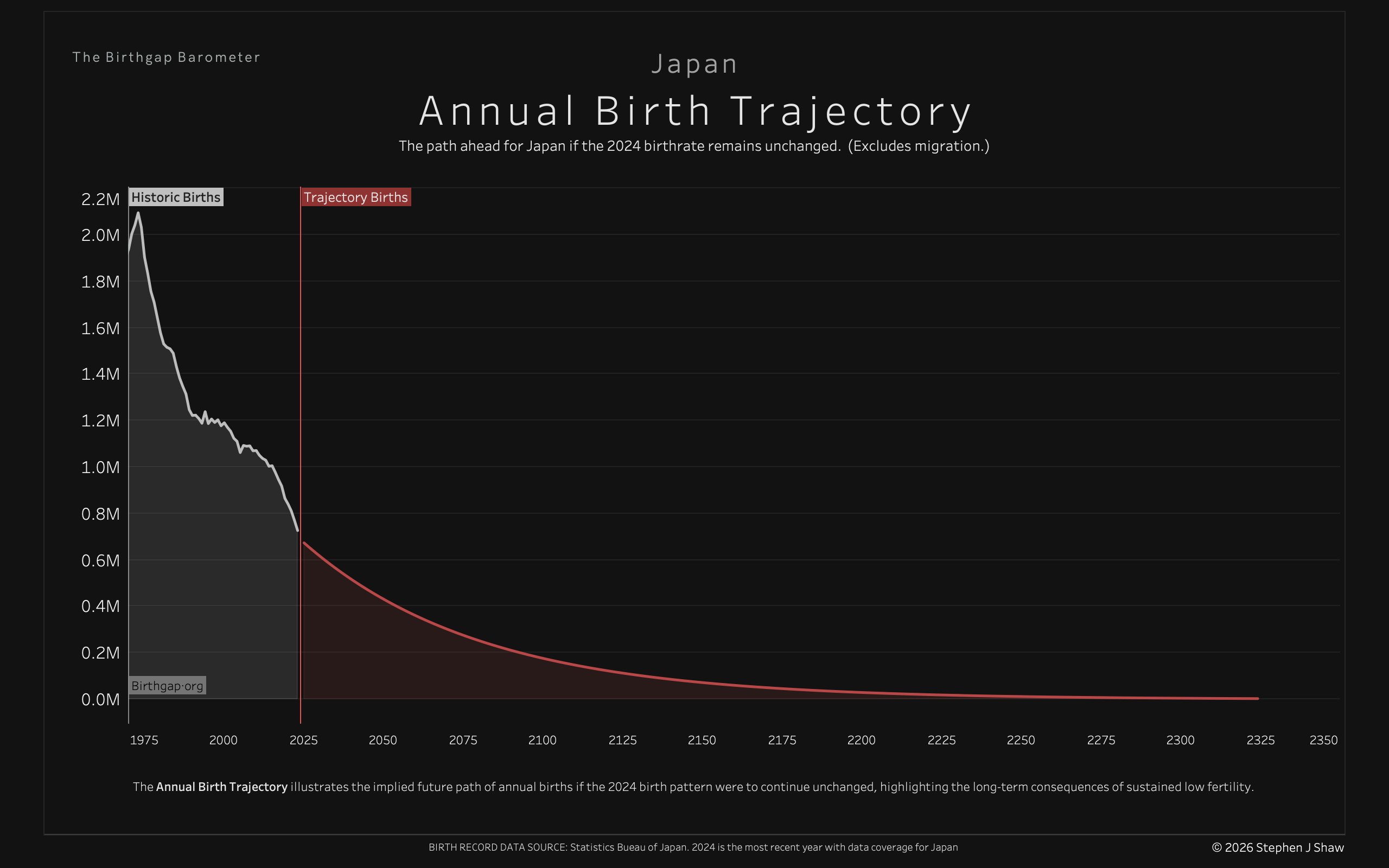
What is the Future Trajectory?(2/6)
How Many Babies Are Born Each Year?(3/6)
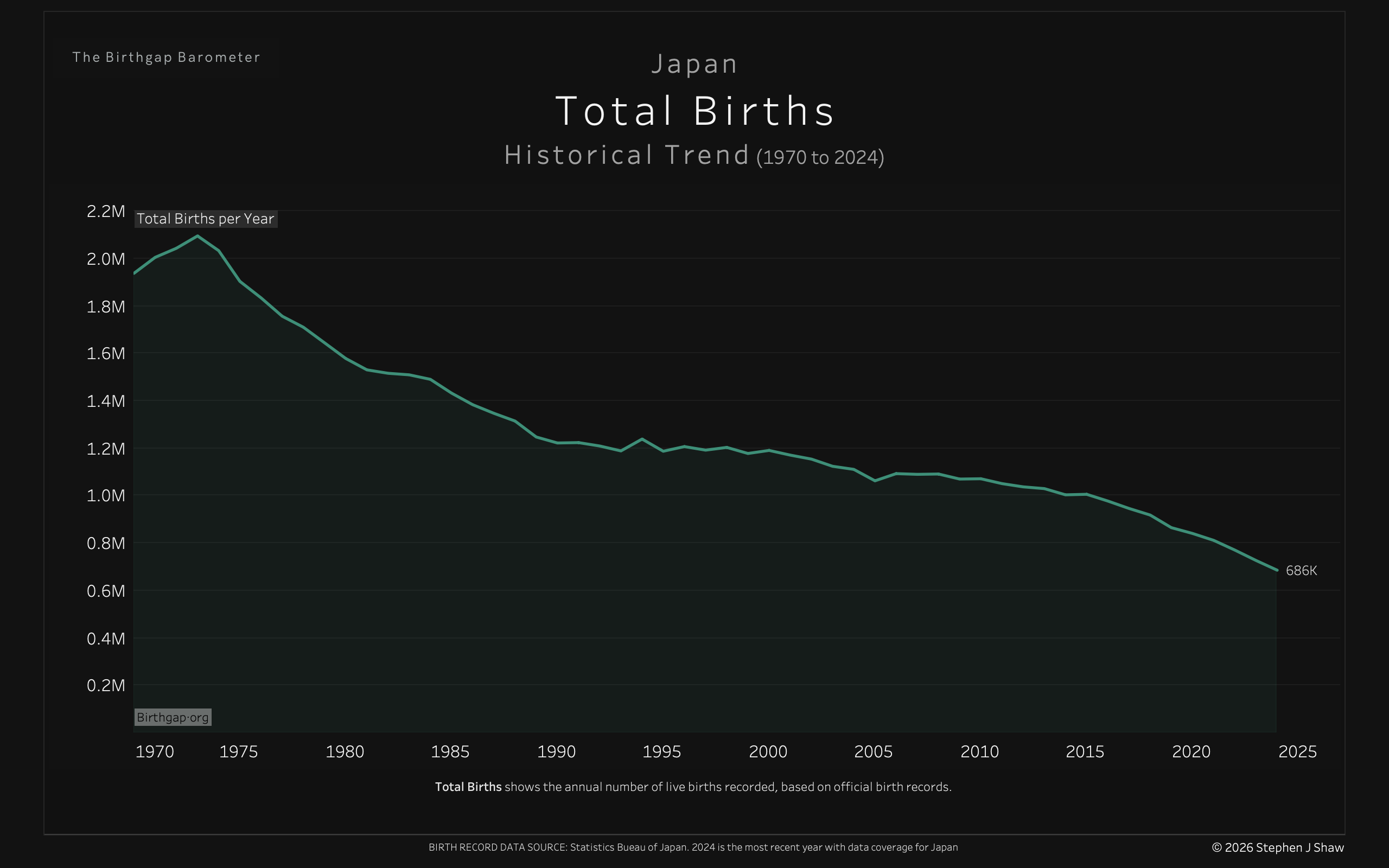
Total annual births are falling, dropping below 700,000.
- 686,173 births were recorded in 2024
- Down 40,988 from the prior year
How Do Births Compare to Future Retirees?(4/6)
Birthgap retirement indicator is on an upward trend.
- The retiree birthgap stands at 65.4% in 2024
- Up 2.4 points from the prior year
How Fast Does One Generation Become Smaller?(5/6)
Where to Go Next(6/6)
For more detailed information, read the full Birthgap Country Report for Japan.
Read the Report →
 United Kingdom
(2013–2024)
United Kingdom
(2013–2024)
2024 Snapshot
Key Trends
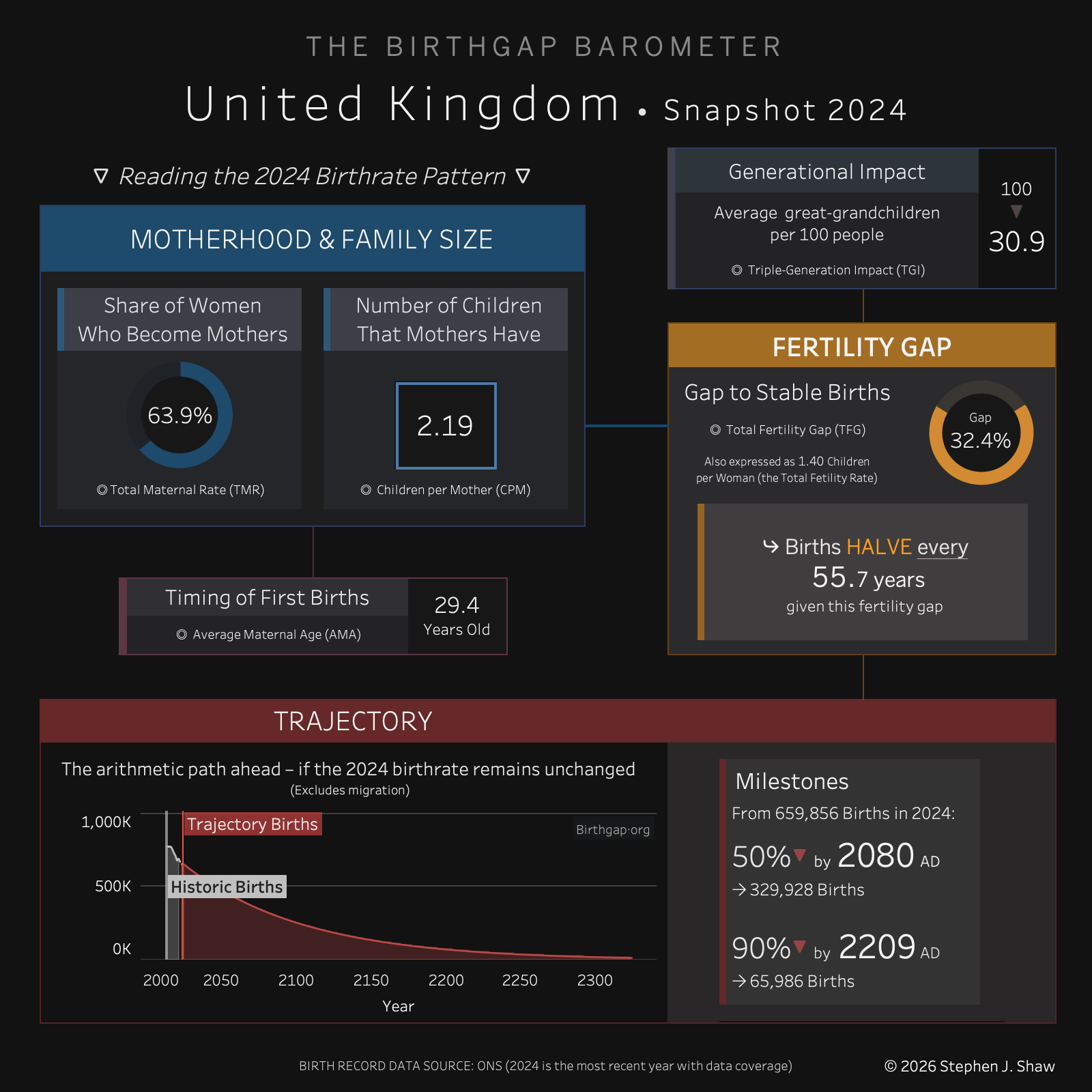
In 2024, the United Kingdom shows a slight decline in fertility with a total maternal rate (TMR) below the global average and a continuing rise in maternal age.
- TMR at 63.9%, ranking 18th out of 38 countries globally
- Children per mother (2.19) declining, ranked 24th globally
- Mean maternal age (29.4 years) rising, ranked 27th
- Total fertility gap (TFG) at 32.4%, up notably from the 2010s
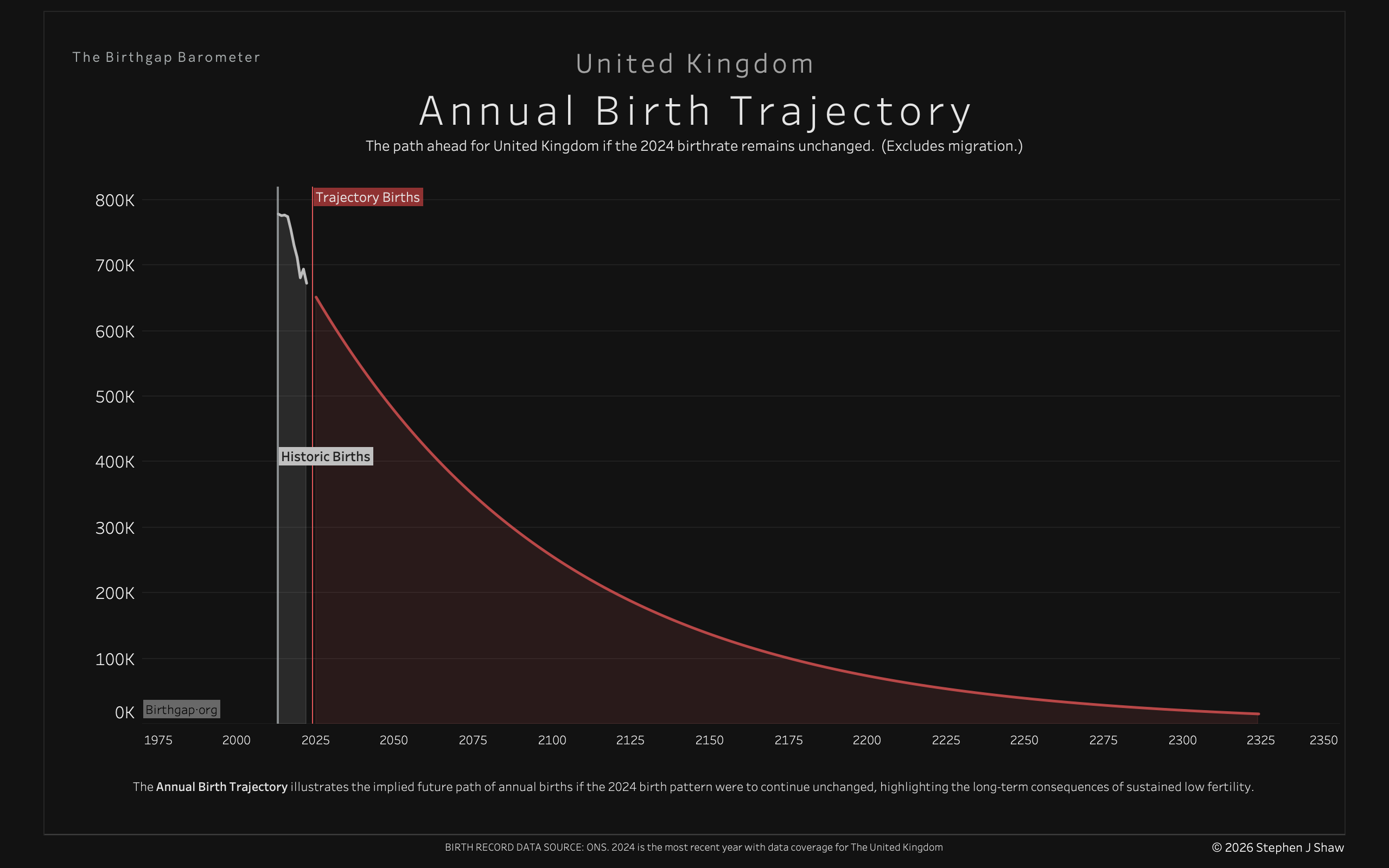
- Births projected to halve by 2080, 90% decline by 2209
What Share of Women Become Mothers?(1/7)
Motherhood prevalence data currently unavailable.
How Many Children Do Mothers Have?(2/7)
Children per mother figures are not reported.
At What Age Do Women Become Mothers?(3/7)
Average maternal age statistics are missing.
What Share of Mothers Have Exactly One Child?(4/7)
Data on one-child motherhood is unavailable.
What Share of Mothers Have Exactly Two Children?(5/7)
Two-child motherhood statistics are not reported.
What Share of Mothers Have Three or More Children?(6/7)
Missing figures on three-plus-child motherhood.
What Share of Women Remain Childless for Life?(7/7)
Childlessness rate information is not provided.
How Low Are Overall Births?(1/6)
No recent data on birthgap generational indicator.
What is the Future Trajectory?(2/6)
How Many Babies Are Born Each Year?(3/6)
Total births data is currently not available.
How Do Births Compare to Future Retirees?(4/6)
Birthgap retirement indicator data is missing.
How Fast Does One Generation Become Smaller?(5/6)
Where to Go Next(6/6)
For more detailed information, read the full Birthgap Country Report for United Kingdom.
Read the Report →
 France
(2013–2024)
France
(2013–2024)
2024 Snapshot
Key Trends
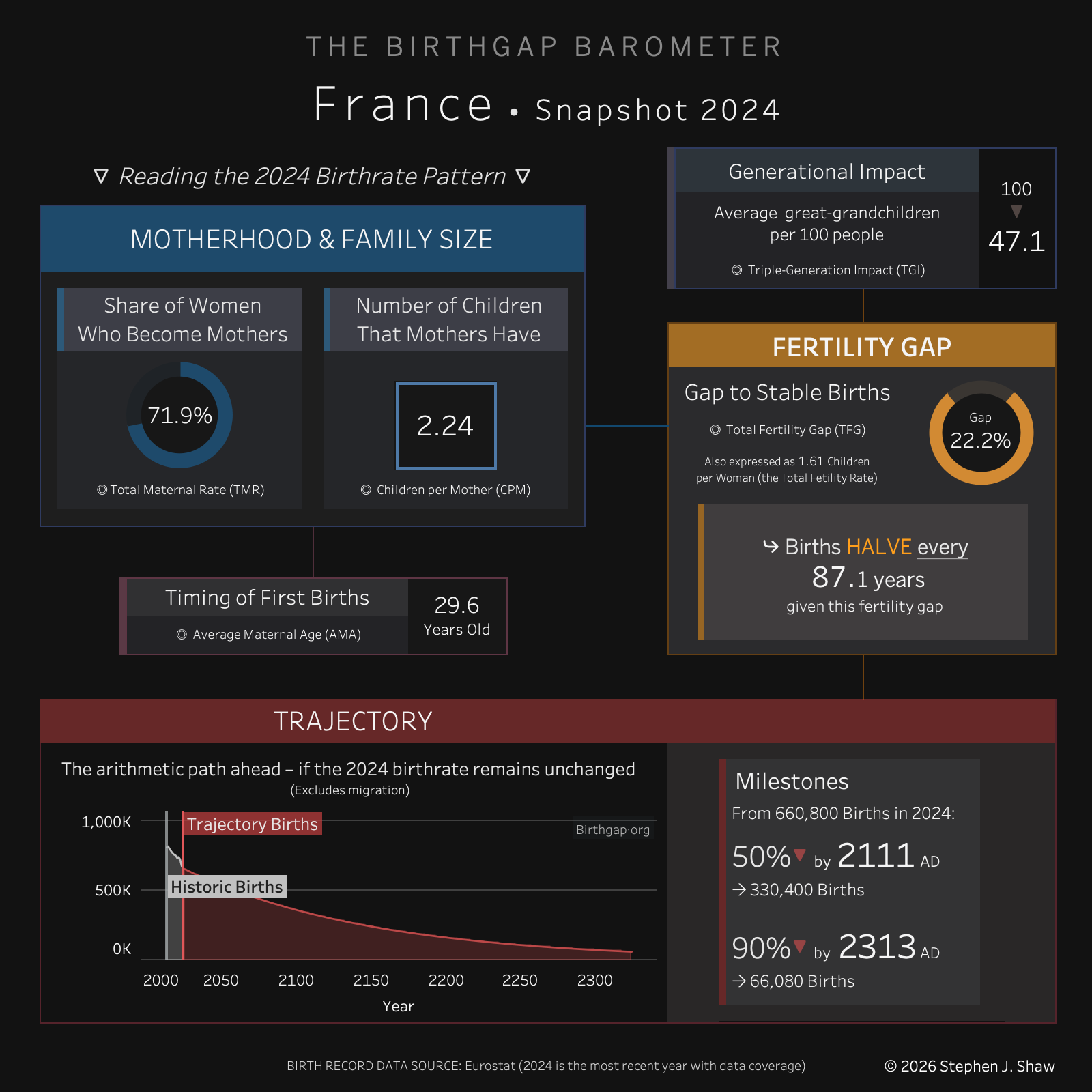
In 2024, France maintains a high total maternal rate but shows declining trends in births and fertility indicators compared to previous decades.
- Third highest total maternal rate globally and in Europe
- Children per mother slightly above European average, mid-range rank
- Mean age at childbearing near European average, ranking 19/31
- Among lowest childlessness and teenage fertility rates in Europe
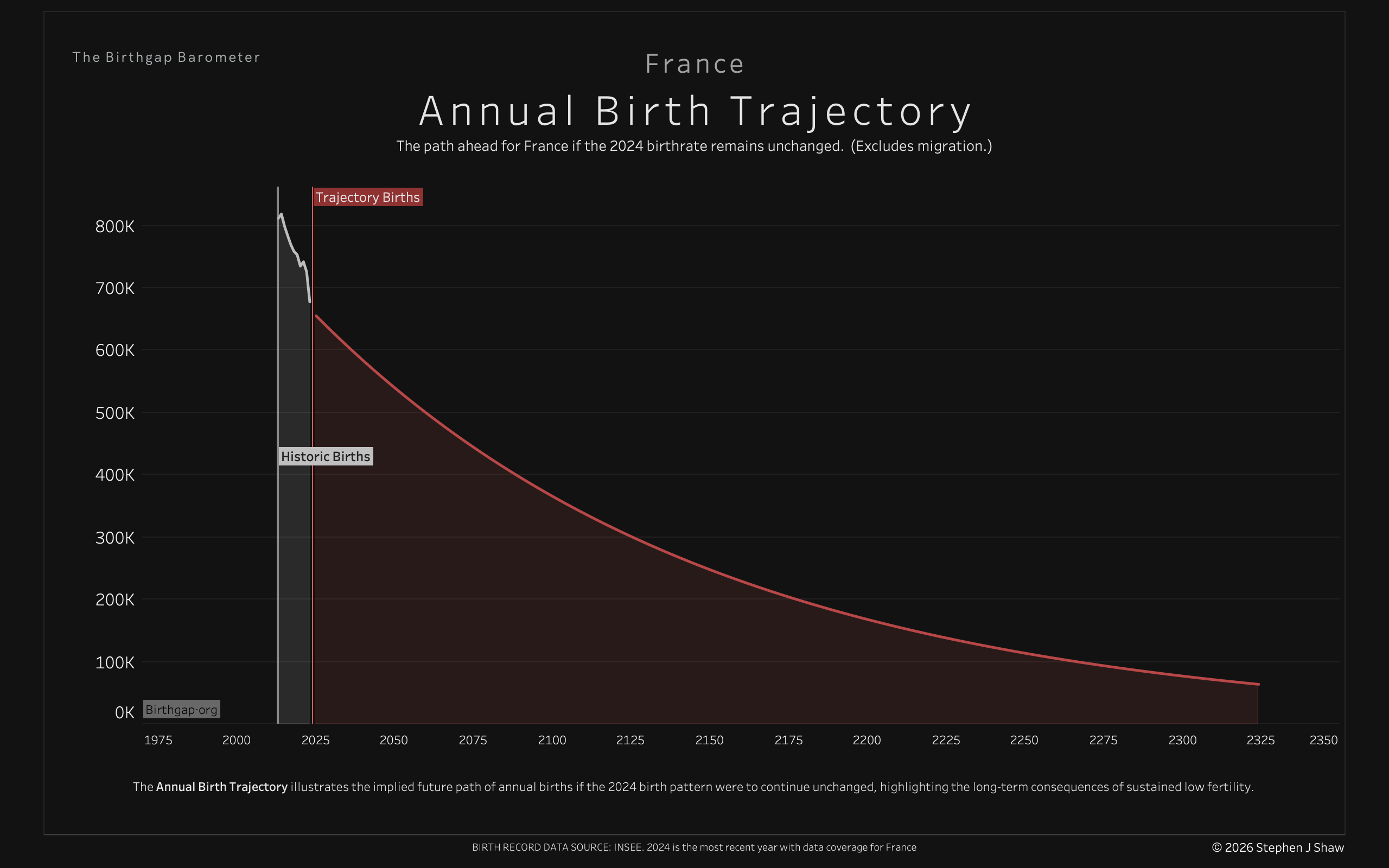
- Projected severe future births decline with a slow societal half-life
What Share of Women Become Mothers?(1/7)
Motherhood prevalence is slightly declining this year.
- 71.9% become mothers in 2024
- Down 0.9 points from the prior year
How Many Children Do Mothers Have?(2/7)
Average children per mother continue to decrease.
- Mothers average 2.24 children in 2024
- Down 0.04 from the prior year
At What Age Do Women Become Mothers?(3/7)
Average maternal age rises, now nearing 30 years.
- Average first-birth age is 29.6 in 2024
- Up 0.2 years from the prior year
What Share of Mothers Have Exactly One Child?(4/7)
More mothers are having only one child.
- 22.9% of mothers have one child in 2024
- Up 2.5 points from the prior year
What Share of Mothers Have Exactly Two Children?(5/7)
Two-child motherhood is experiencing a slight decline.
- 45.1% of mothers have two children in 2024
- Down 1.2 points from the prior year
What Share of Mothers Have Three or More Children?(6/7)
Mothers with three or more children are decreasing.
- 32.0% of mothers have three or more in 2024
- Down 1.3 points from the prior year
What Share of Women Remain Childless for Life?(7/7)
Childlessness rate is gradually on the rise.
- 28.1% remain childless in 2024
- Up 0.9 points from the prior year
How Low Are Overall Births?(1/6)
Birthgap generational indicator shows a subtle increase.
- The birthgap stands at 22.2% in 2024
- Up 2.4 points from the prior year
What is the Future Trajectory?(2/6)
How Many Babies Are Born Each Year?(3/6)
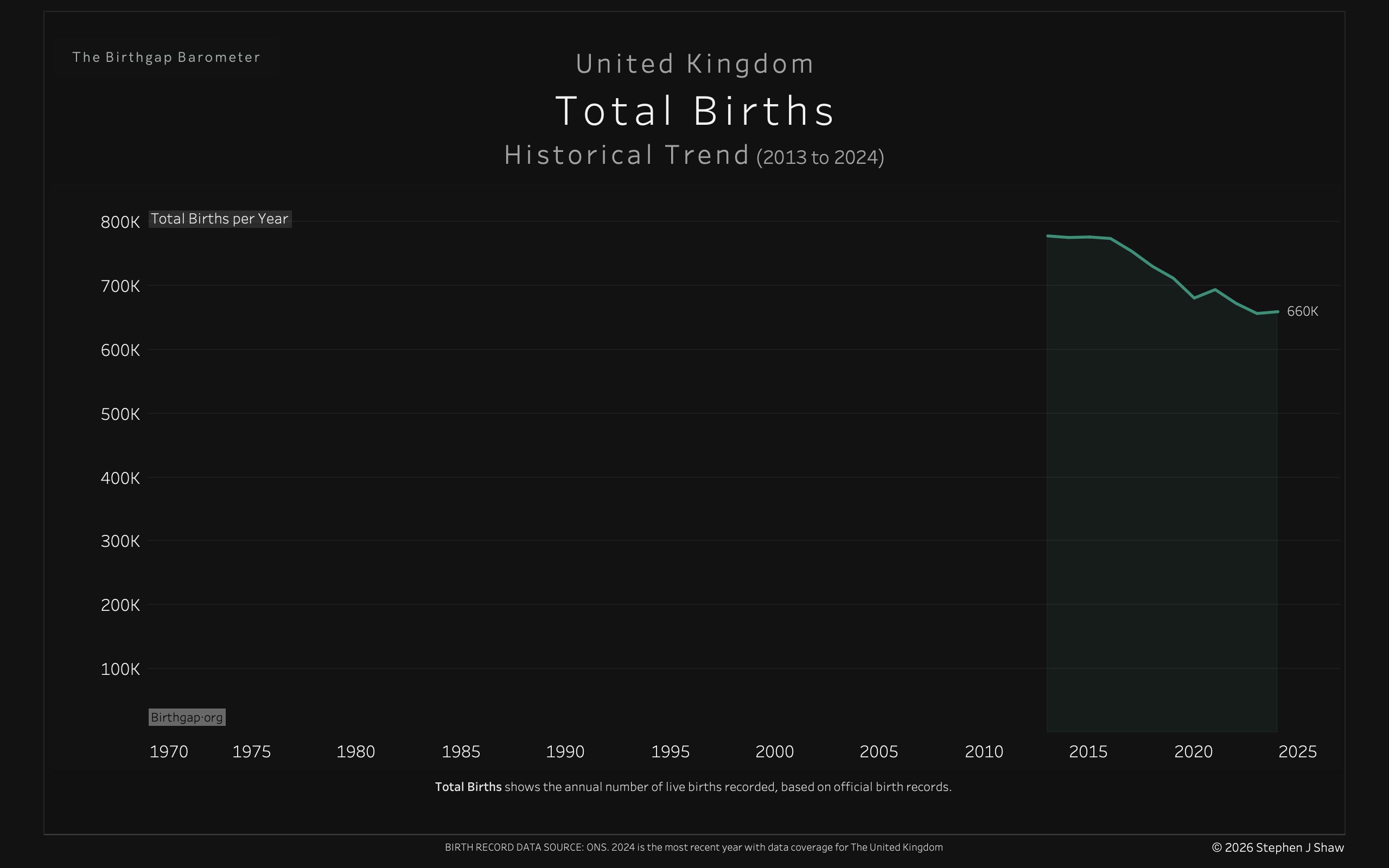
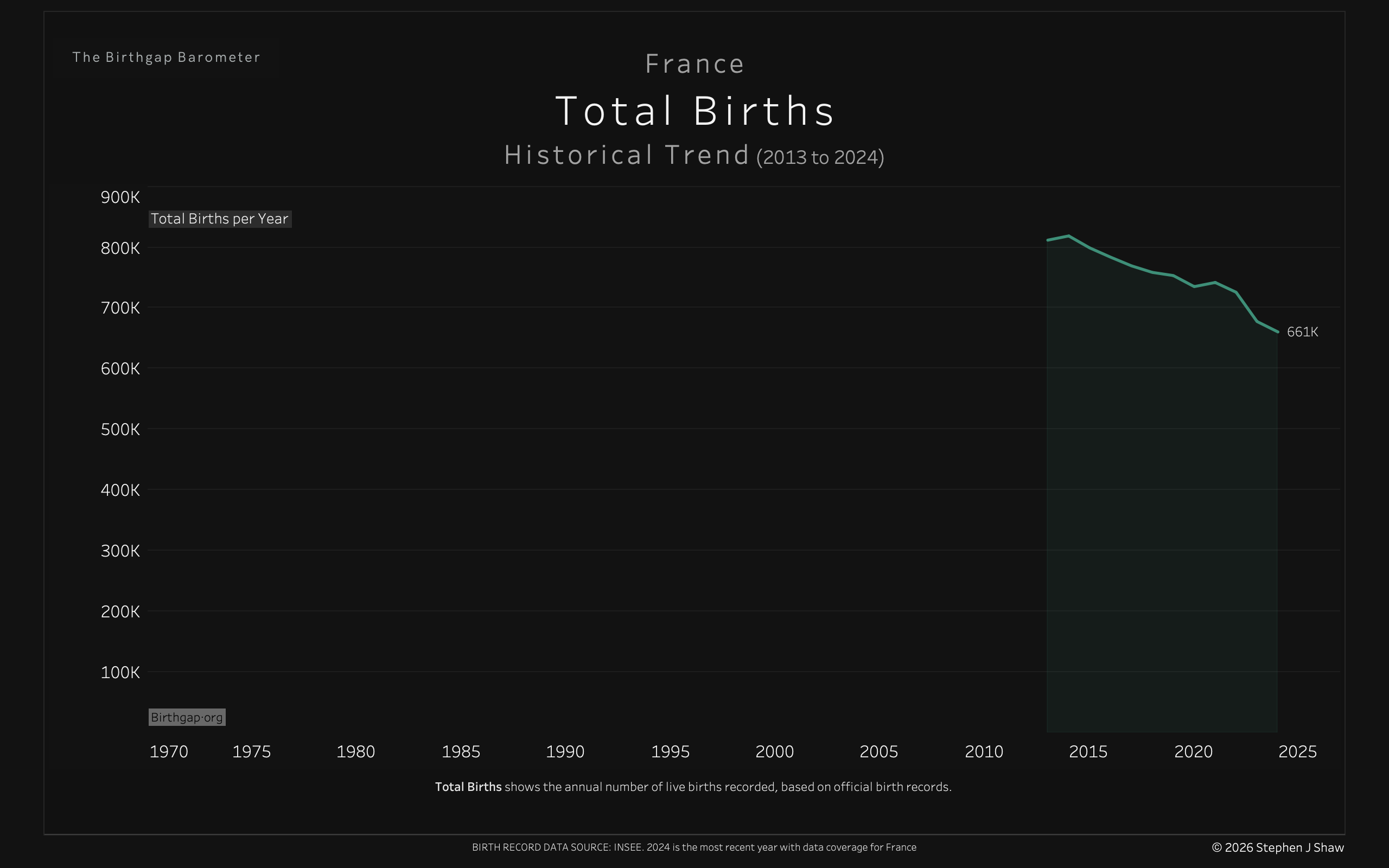
Total births have decreased compared to last year.
- 660,800 births were recorded in 2024
- Down 17,164 from the prior year
How Do Births Compare to Future Retirees?(4/6)
Birthgap retirement indicator slightly increases over five years.
- The retiree birthgap stands at 27.5% in 2024
- Up 0.4 points from the prior year
How Fast Does One Generation Become Smaller?(5/6)
Where to Go Next(6/6)
For more detailed information, read the full Birthgap Country Report for France.
Read the Report →
 Germany
(2009–2024)
Germany
(2009–2024)
2024 Snapshot
Key Trends
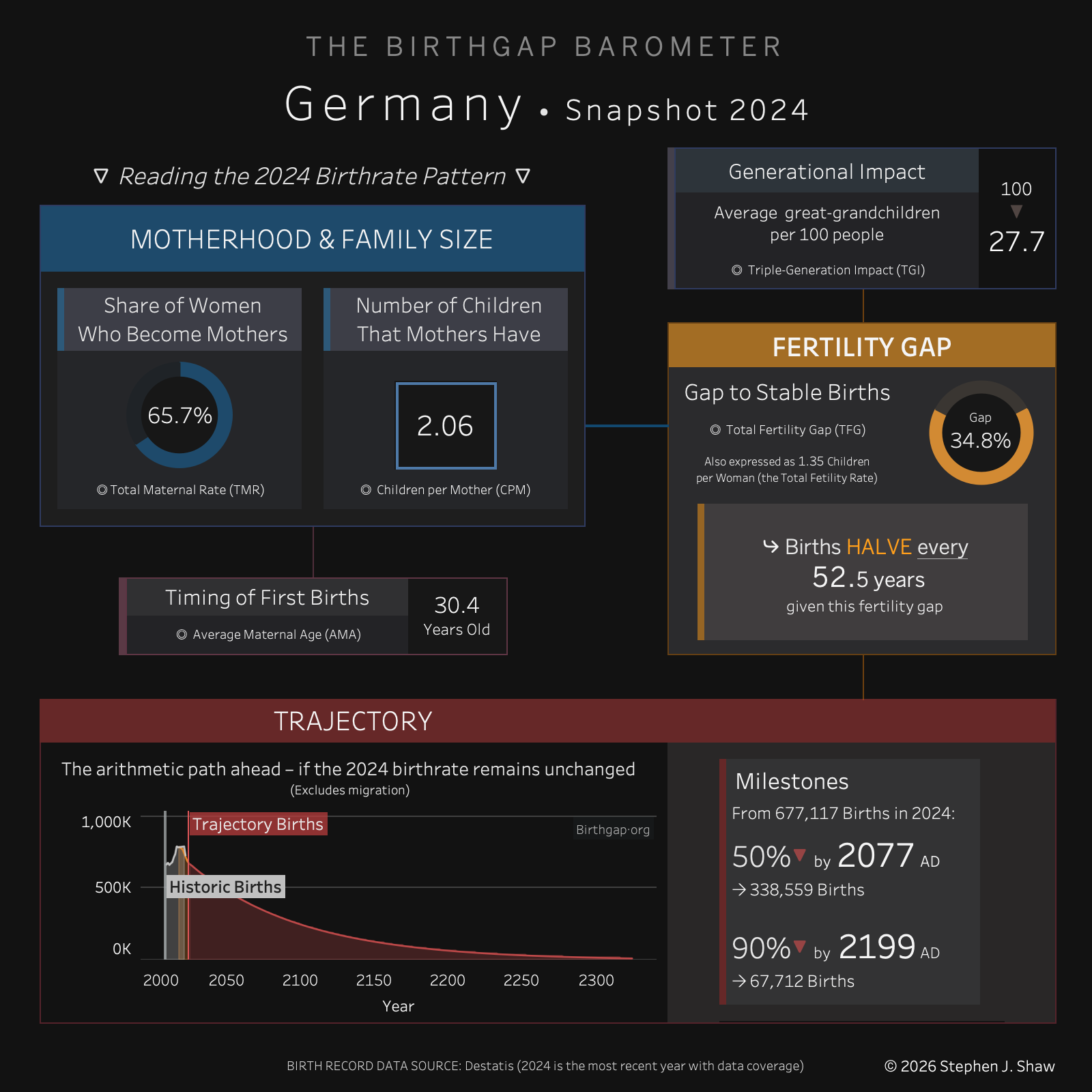
In 2024, Germany exhibited moderate fertility indicators, with fertility and children per mother slightly below European averages but stable overall.
- Completed fertility at 65.7%, ranking 11th in Europe
- Children per mother steady at 2.06, slightly below average
- Average maternal age rising, now at 30.4 years, 11th highest in Europe
- Childlessness increasing, ranking 21st in Europe
- Birthgap generational potential moderate, with a 34.8% indicator
What Share of Women Become Mothers?(1/7)
Motherhood prevalence continues a slight downward trend in 2024.
- 65.7% become mothers in 2024
- Down 1.1 points from the prior year
How Many Children Do Mothers Have?(2/7)
Average children per mother declines modestly amid long-term drop.
- Mothers average 2.06 children in 2024
- Down 0.02 from the prior year
At What Age Do Women Become Mothers?(3/7)
Average maternal age rises steadily, now over 30 years old.
- Average first-birth age is 30.4 in 2024
- Up 0.1 years from the prior year
What Share of Mothers Have Exactly One Child?(4/7)
One-child families gain ground, showing a rising share.
- 24.4% of mothers have one child in 2022
- Up 2.0 points from the prior year
What Share of Mothers Have Exactly Two Children?(5/7)
Two-child families experience a small decline in prevalence.
- 49.4% of mothers have two children in 2022
- Down 1.3 points from the prior year
What Share of Mothers Have Three or More Children?(6/7)
Mothers with three or more children continue a slight fall.
- 26.2% of mothers have three or more in 2022
- Down 0.7 points from the prior year
What Share of Women Remain Childless for Life?(7/7)
Childlessness rate increases, reflecting changing family patterns.
- 34.3% remain childless in 2024
- Up 1.1 points from the prior year
How Low Are Overall Births?(1/6)
Birthgap indicator edges up, hinting at generational fertility shifts.
- The birthgap stands at 34.8% in 2024
- Up 1.9 points from the prior year
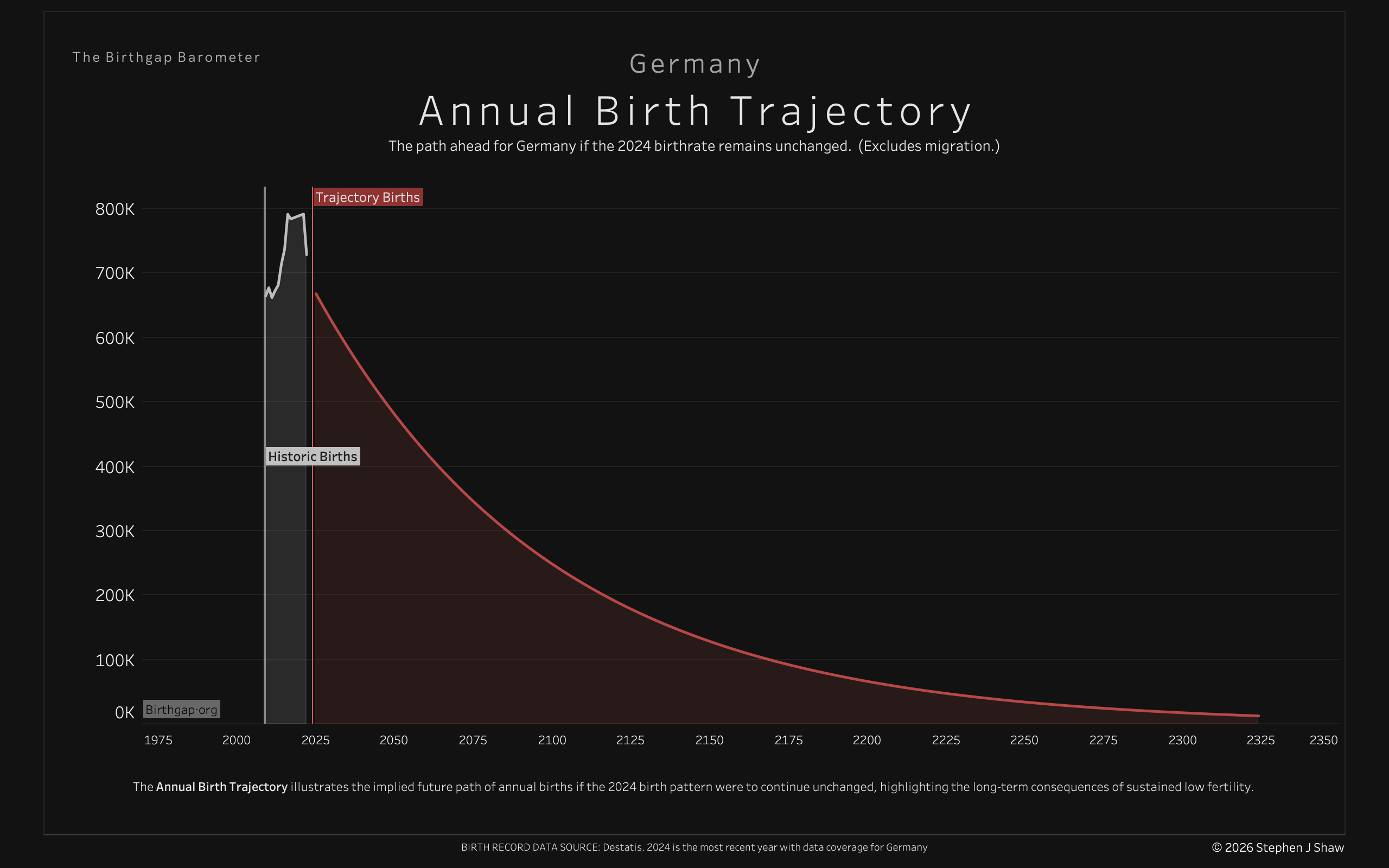
What is the Future Trajectory?(2/6)
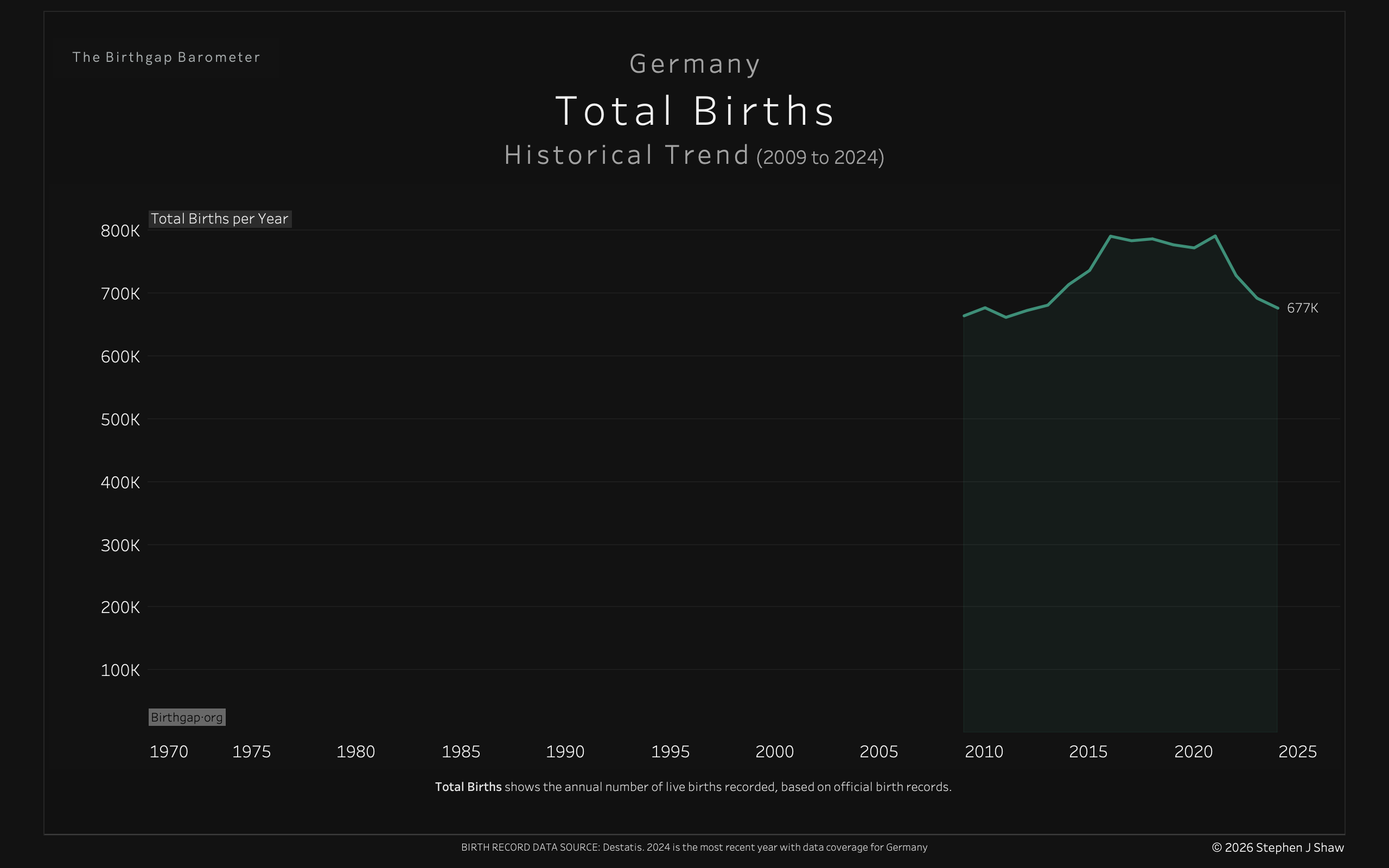
How Many Babies Are Born Each Year?(3/6)
Total births decrease, continuing a recent downward pattern.
- 677,117 births were recorded in 2024
- Down 15,872 from the prior year
How Do Births Compare to Future Retirees?(4/6)
Birthgap retirement indicator declines, signaling demographic shifts.
- The retiree birthgap stands at 29.4% in 2024
- Down 3.8 points from the prior year
How Fast Does One Generation Become Smaller?(5/6)
Where to Go Next(6/6)
For more detailed information, read the full Birthgap Country Report for Germany.
Read the Report →
 Italy
(2003–2024)
Italy
(2003–2024)
2024 Snapshot
Key Trends
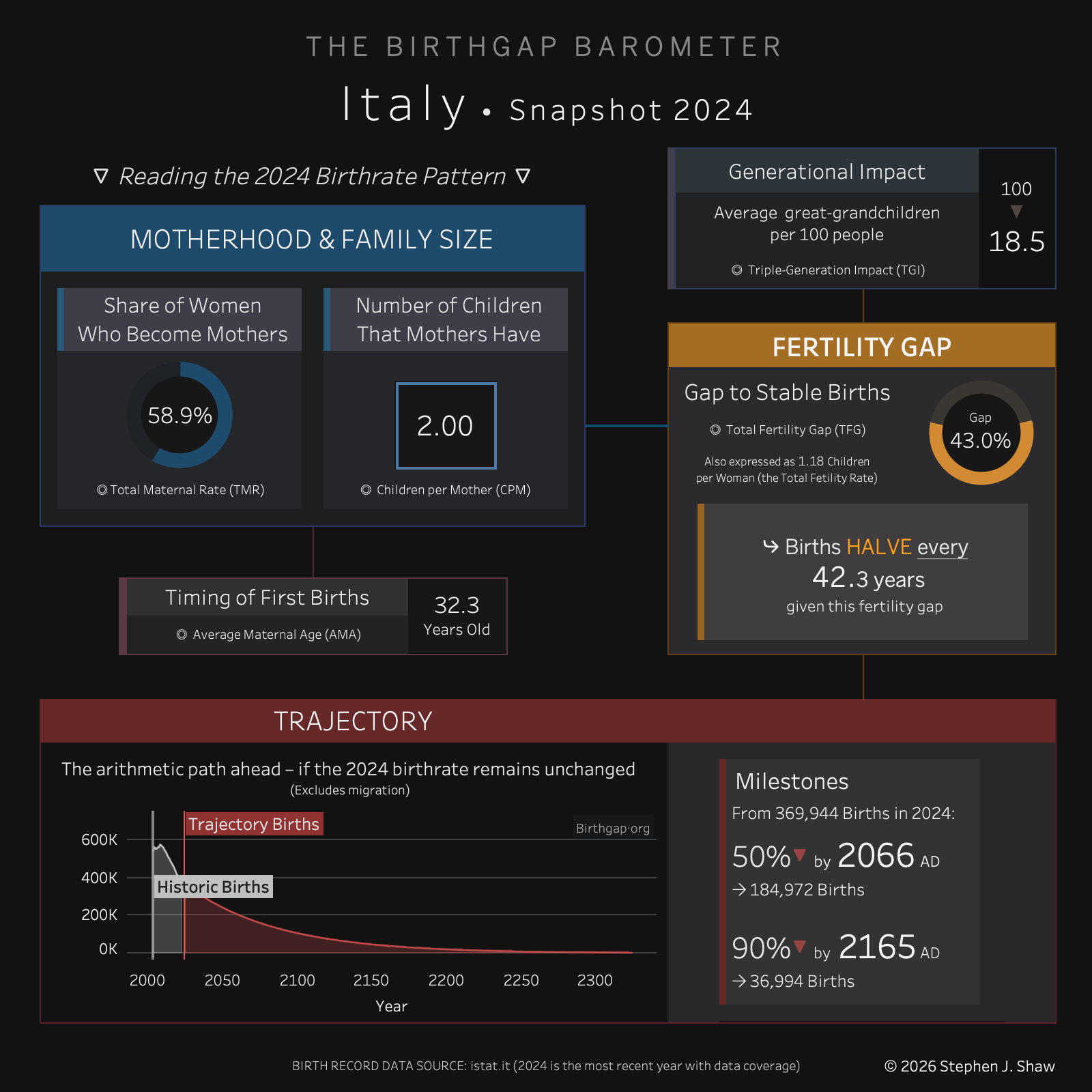
In 2024, Italy's fertility and birth dynamics show continued decline in total maternal rate amid rising average maternal age and ongoing shifts in childlessness and family size patterns.
- Total maternal rate slightly down, ranking 24th in Europe
- Children per mother stable but below European average, ranked 8th
- Highest average maternal age in Europe at over 32 years
- Childlessness rate among highest in Europe, ranked 6th
- Birthgap Retirement Indicator highest in Europe, indicating aging population
What Share of Women Become Mothers?(1/7)
Motherhood prevalence continues a subtle downward trend in 2024.
- 58.9% become mothers in 2024
- Down 0.6 points from the prior year
How Many Children Do Mothers Have?(2/7)
Average children per mother decline slightly as family sizes shrink.
- Mothers average 2.00 children in 2024
- Down 0.01 from the prior year
At What Age Do Women Become Mothers?(3/7)
Average maternal age rises to 32.3 years, reflecting delayed motherhood.
- Average first-birth age is 32.3 in 2024
- Up 0.1 years from the prior year
What Share of Mothers Have Exactly One Child?(4/7)
One-child families grow more common, now over a quarter of mothers.
- 26.0% of mothers have one child in 2023
- Up 1.1 points from the prior year
What Share of Mothers Have Exactly Two Children?(5/7)
Two-child families decline slightly but remain the majority.
- 51.8% of mothers have two children in 2023
- Down 1.3 points from the prior year
What Share of Mothers Have Three or More Children?(6/7)
Families with three or more children continue a slow decrease.
- 22.1% of mothers have three or more in 2023
- Up 0.1 points from the prior year
What Share of Women Remain Childless for Life?(7/7)
Childlessness rate shows a modest increase, nearing 41%.
- 41.1% remain childless in 2024
- Up 0.6 points from the prior year
How Low Are Overall Births?(1/6)
Birthgap indicator rises, suggesting generational intervals are expanding.
- The birthgap stands at 43.0% in 2024
- Up 1.0 points from the prior year
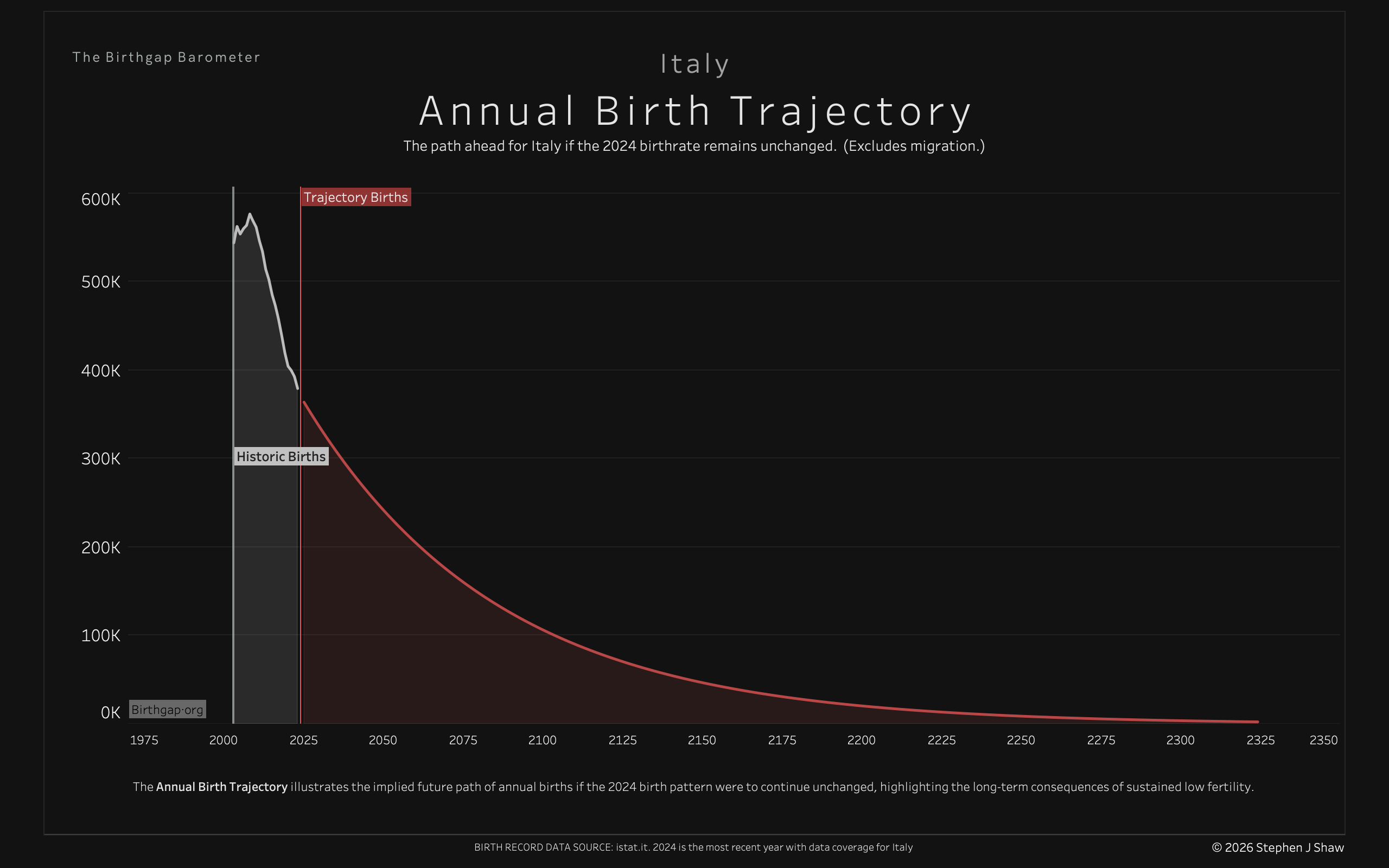
What is the Future Trajectory?(2/6)
How Many Babies Are Born Each Year?(3/6)
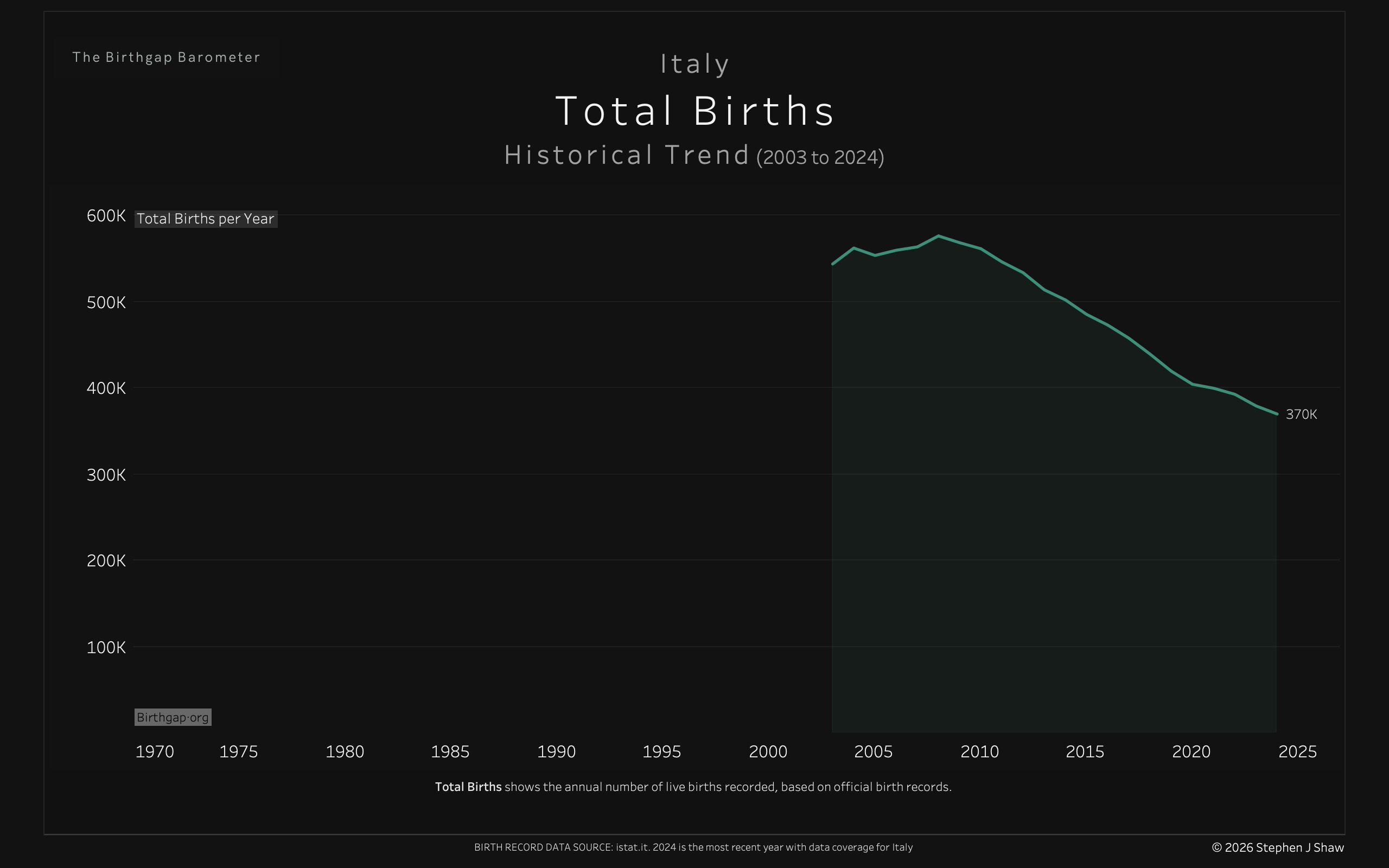
Total births fall by nearly ten thousand, extending a multi-year decline.
- 369,944 births were recorded in 2024
- Down 9,422 from the prior year
How Do Births Compare to Future Retirees?(4/6)
Birthgap retirement indicator edges up, hinting at demographic shifts.
- The retiree birthgap stands at 60.7% in 2024
- Up 0.7 points from the prior year
How Fast Does One Generation Become Smaller?(5/6)
Where to Go Next(6/6)
For more detailed information, read the full Birthgap Country Report for Italy.
Read the Report →
 South Korea
(2000–2024)
South Korea
(2000–2024)
2024 Snapshot
Key Trends
In 2024, South Korea's demographic indicators reflect continued declines in fertility and family size, coupled with increasing childbearing age and societal aging.
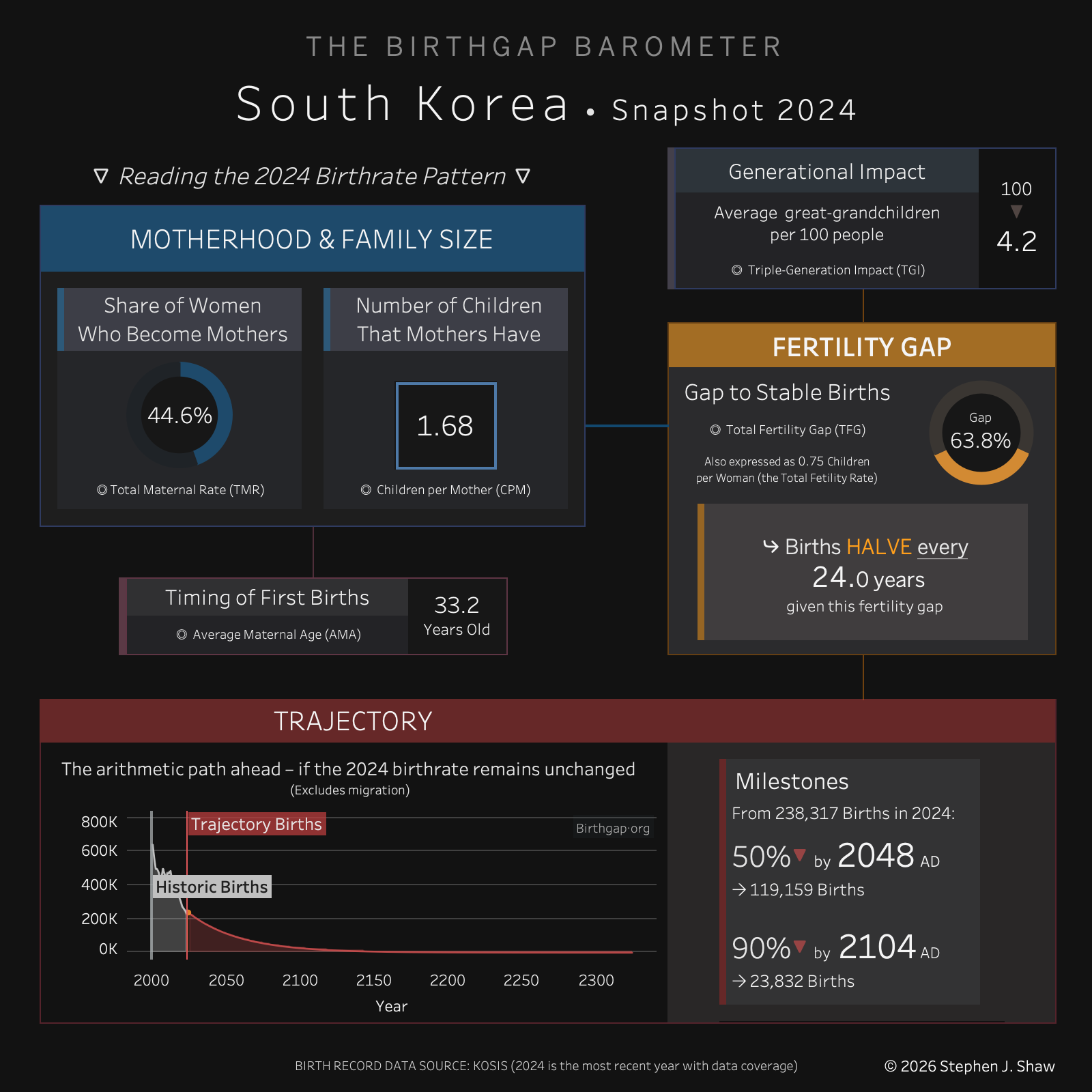
- Lowest total motherhood rate globally (44.6%)
- Lowest children per mother rate worldwide (1.68)
- Highest average maternal age in the dataset (33.2 years)
- Highest childlessness rate globally (55.4%)
- Shortest societal half-life globally (24.0 years)
What Share of Women Become Mothers?(1/7)
Motherhood prevalence slightly decreases amid a long-term decline.
- 44.6% become mothers in 2024
- Up 1.2 points from the prior year
How Many Children Do Mothers Have?(2/7)
Average children per mother edges down, continuing a five-year drop.
- Mothers average 1.68 children in 2024
- Up 0.02 from the prior year
At What Age Do Women Become Mothers?(3/7)
Average maternal age increases, now surpassing 33 years.
- Average first-birth age is 33.2 in 2024
- Up 0.3 years from the prior year
What Share of Mothers Have Exactly One Child?(4/7)
One-child motherhood rises notably, becoming more common recently.
- 46.3% of mothers have one child in 2023
- Up 4.2 points from the prior year
What Share of Mothers Have Exactly Two Children?(5/7)
Two-child motherhood declines, reflecting shifting family size patterns.
- 43.4% of mothers have two children in 2023
- Down 2.8 points from the prior year
What Share of Mothers Have Three or More Children?(6/7)
Families with three or more children continue to decrease.
- 10.4% of mothers have three or more in 2023
- Down 1.4 points from the prior year
What Share of Women Remain Childless for Life?(7/7)
Childlessness rate grows steadily over the past five years.
- 55.4% remain childless in 2024
- Down 1.2 points from the prior year
How Low Are Overall Births?(1/6)
Birthgap Generational Indicator rises, despite a recent small decrease.
- The birthgap stands at 63.8% in 2024
- Down 1.3 points from the prior year
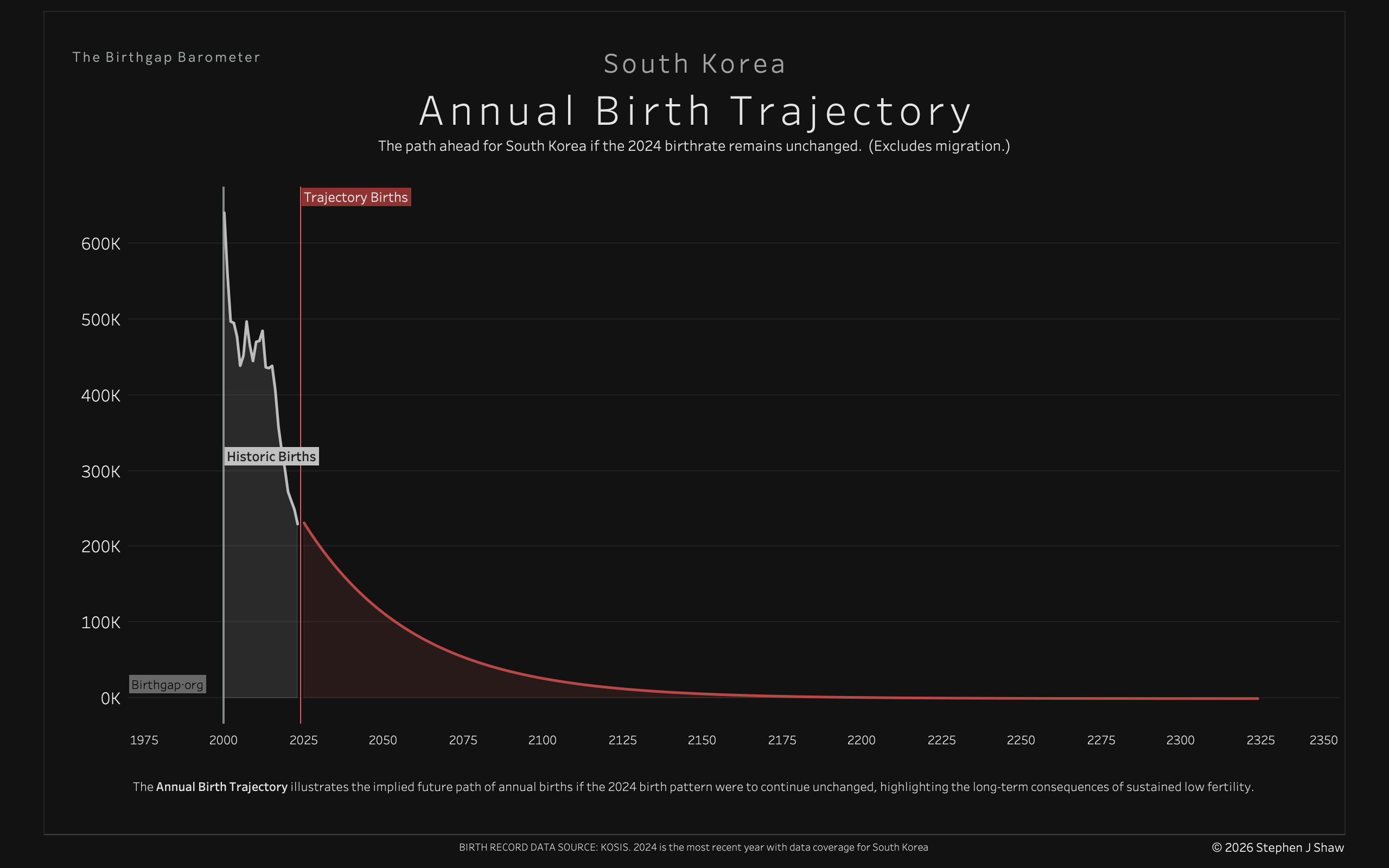
What is the Future Trajectory?(2/6)
How Many Babies Are Born Each Year?(3/6)
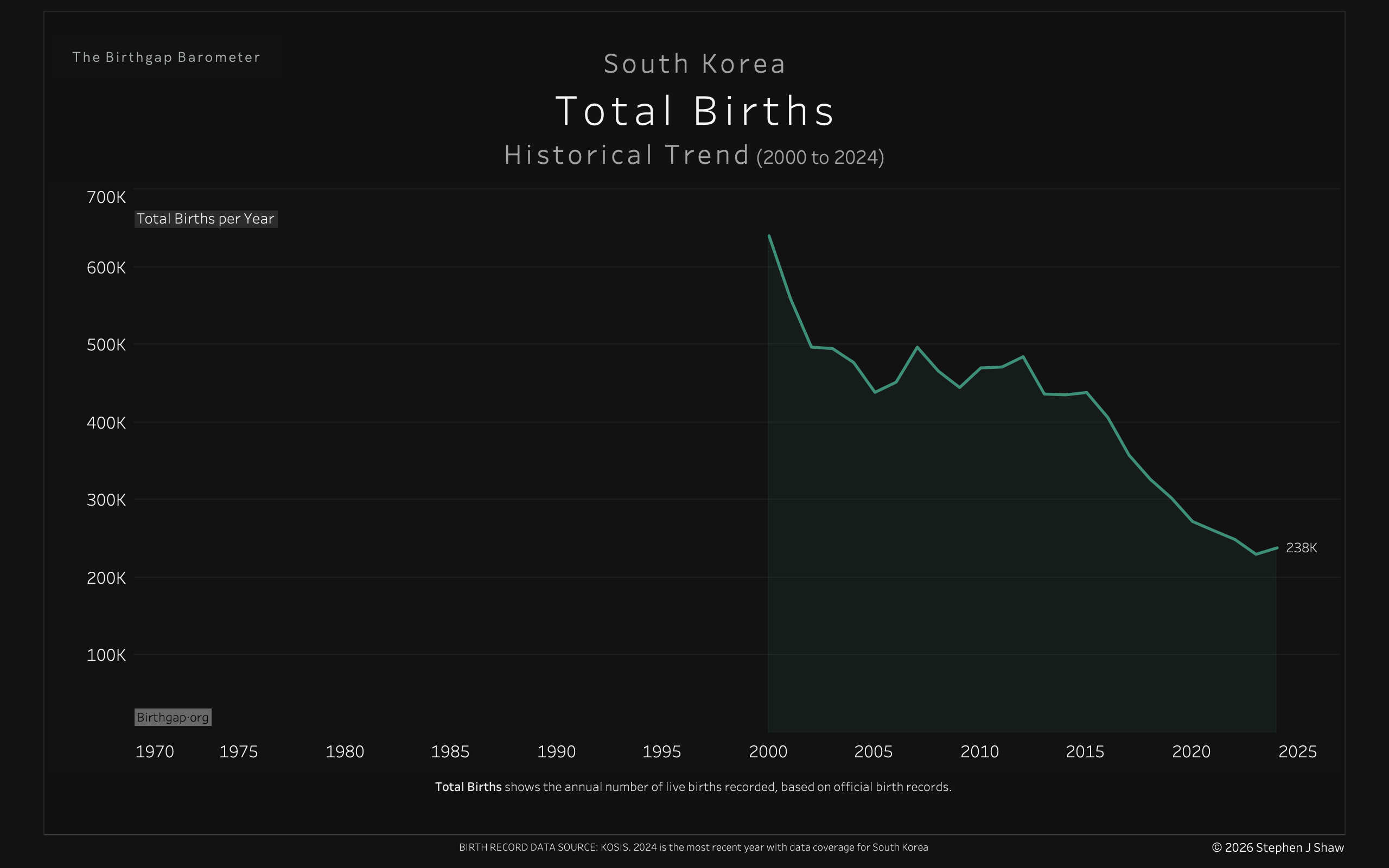
Total births fall overall despite a recent uptick in 2024.
- 238,317 births were recorded in 2024
- Up 8,303 from the prior year
How Do Births Compare to Future Retirees?(4/6)
Birthgap Retirement Indicator rises moderately over five years.
- The retiree birthgap stands at 72.8% in 2024
- Down 1.0 points from the prior year
How Fast Does One Generation Become Smaller?(5/6)
Where to Go Next(6/6)
For more detailed information, read the full Birthgap Country Report for South Korea.
Read the Report →
 Taiwan
(1976–2024)
Taiwan
(1976–2024)
2024 Snapshot
Key Trends
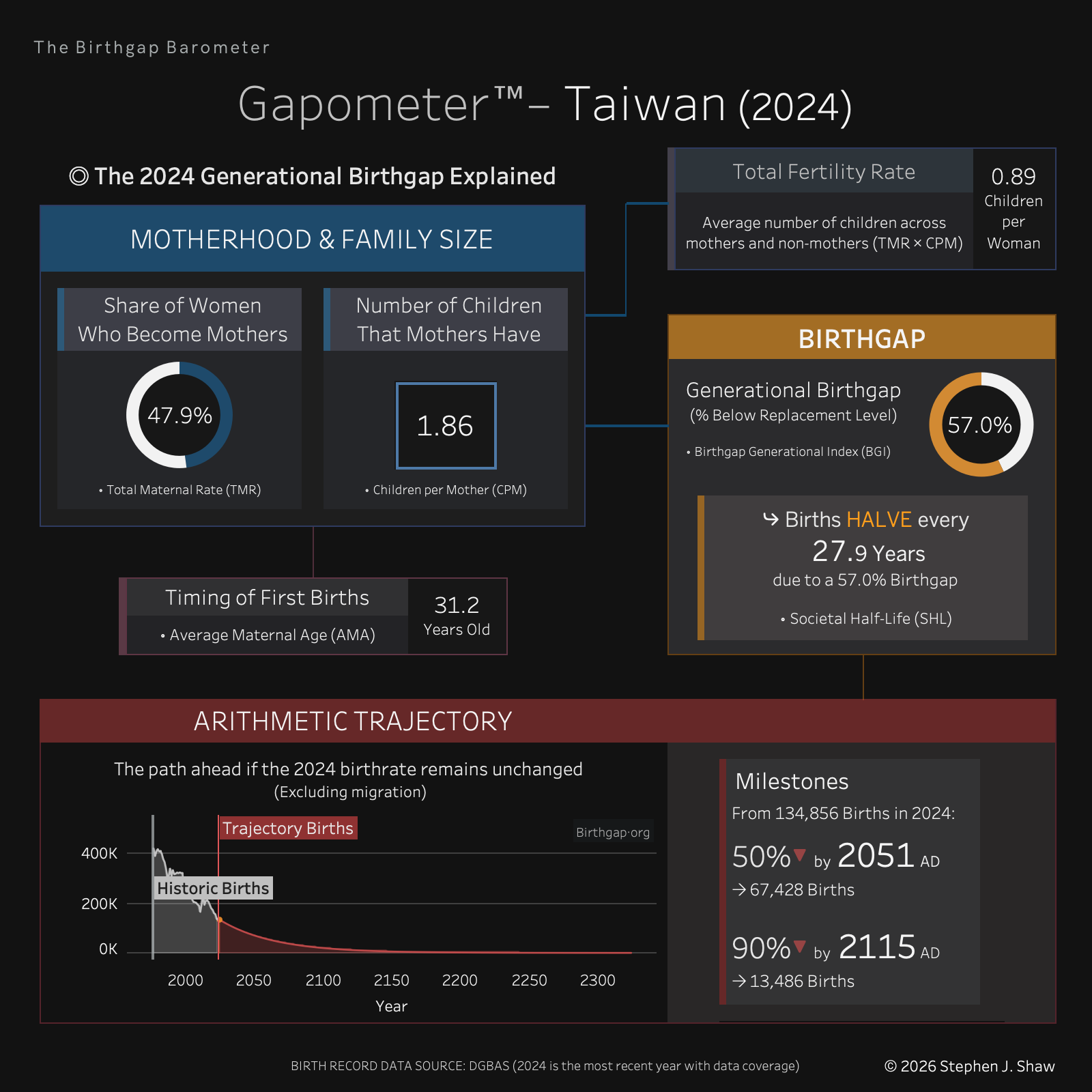
In 2024, Taiwan continued to show very low fertility with significant generational declines and high rates of childlessness amid rising maternal age.
- Total maternal rate at 47.8%, ranked 37th lowest globally among 38 countries
- Children per mother steady at 1.86, fifth lowest worldwide
- Lifetime childlessness high at 52.2%, second highest globally
- Generational Birthgap very pronounced, ranked 2nd highest internationally
- Average maternal age at birth 31.2 years, ninth oldest globally
What Share of Women Become Mothers?(1/7)
Motherhood prevalence slightly decreases, continuing a five-year decline.
- 47.8% become mothers in 2024
- Up 0.9 points from the prior year
How Many Children Do Mothers Have?(2/7)
Children per mother remain below two, following a downward trend.
- Mothers average 1.86 children in 2024
- Up 0.02 from the prior year
At What Age Do Women Become Mothers?(3/7)
Average maternal age rises steadily over the past five years.
- Average first-birth age is 31.2 in 2024
- Up 0.2 years from the prior year
What Share of Mothers Have Exactly One Child?(4/7)
Proportion of one-child mothers modestly grows this year.
- 35.1% of mothers have one child in 2023
- Up 0.4 points from the prior year
What Share of Mothers Have Exactly Two Children?(5/7)
Two-child motherhood is declining despite a slight annual increase.
- 48.2% of mothers have two children in 2023
- Up 0.5 points from the prior year
What Share of Mothers Have Three or More Children?(6/7)
Mothers with three or more children continue to decline.
- 16.7% of mothers have three or more in 2023
- Down 0.8 points from the prior year
What Share of Women Remain Childless for Life?(7/7)
Childlessness rate is increasing steadily over five years.
- 52.2% remain childless in 2024
- Down 0.9 points from the prior year
How Low Are Overall Births?(1/6)
Birthgap generational indicator shows a small recent drop yet long-term rise.
- The birthgap stands at 57.0% in 2024
- Down 1.3 points from the prior year
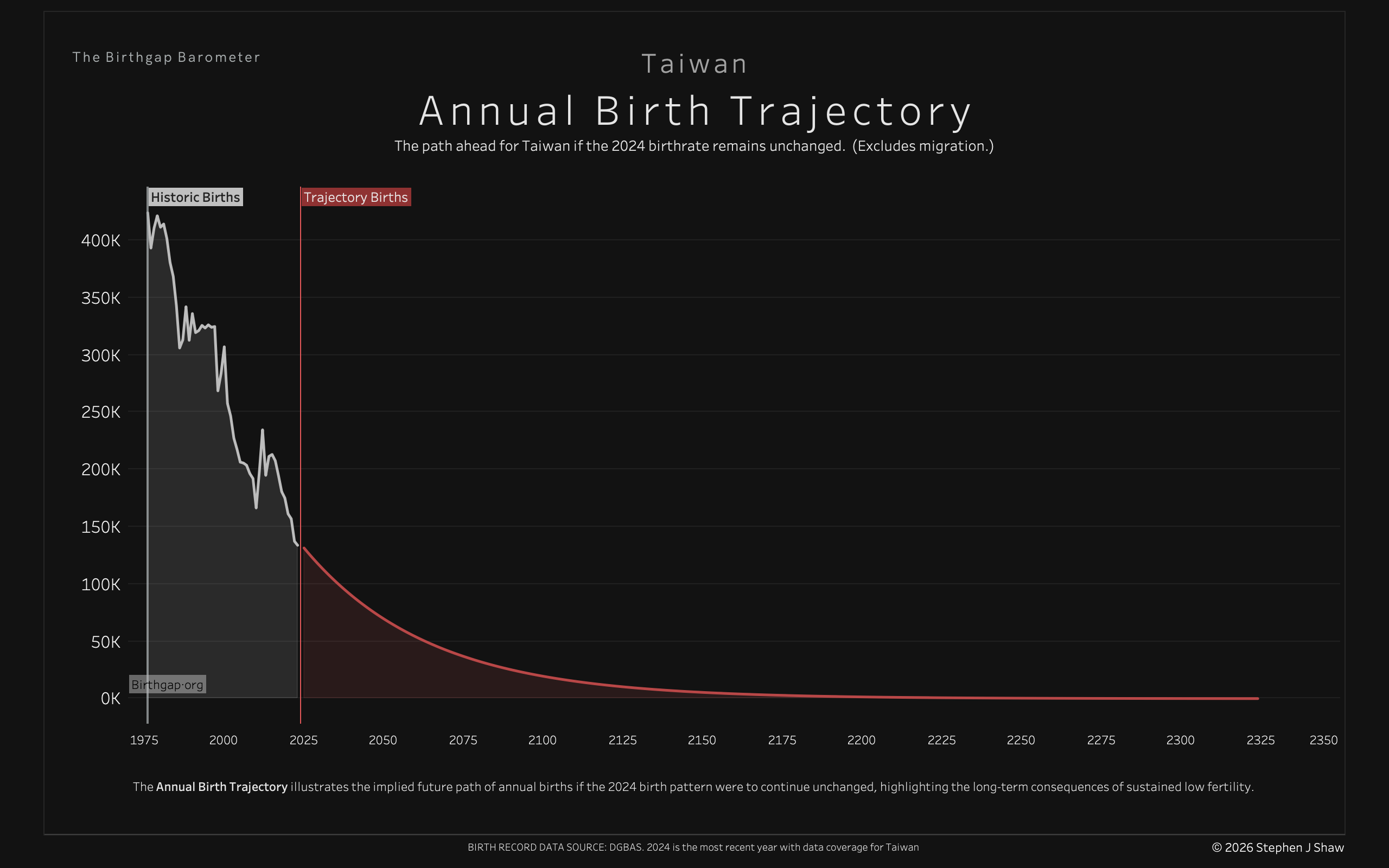
What is the Future Trajectory?(2/6)
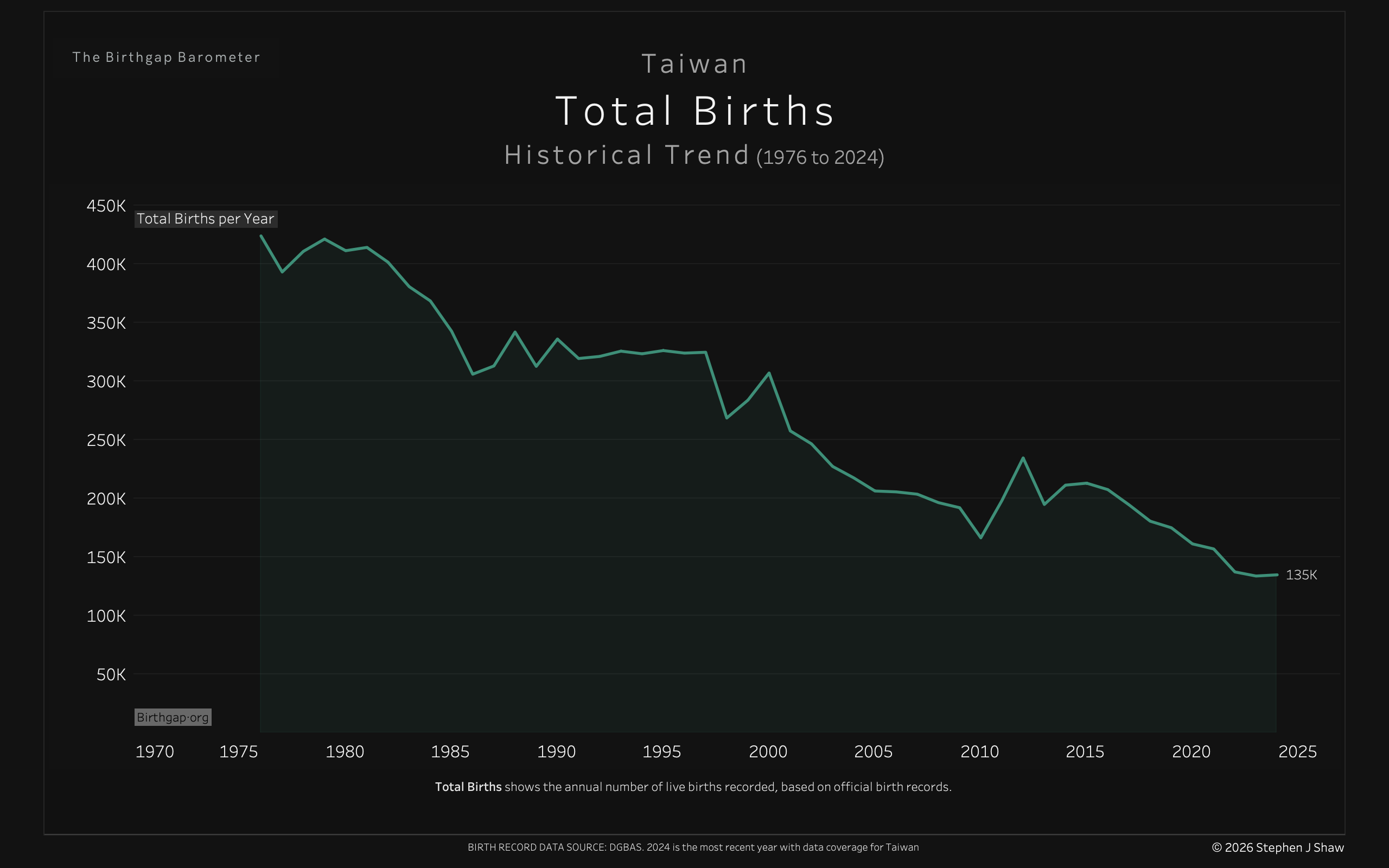
How Many Babies Are Born Each Year?(3/6)
Total births fall slightly despite a minor annual rise.
- 134,856 births were recorded in 2024
- Up 1,024 from the prior year
How Do Births Compare to Future Retirees?(4/6)
Birthgap retirement indicator increases gradually over five years.
- The retiree birthgap stands at 61.0% in 2024
- Up 0.0 points from the prior year
How Fast Does One Generation Become Smaller?(5/6)
Where to Go Next(6/6)
For more detailed information, read the full Birthgap Country Report for Taiwan.
Read the Report →
 Spain
(1975–2024)
Spain
(1975–2024)
2024 Snapshot
Key Trends
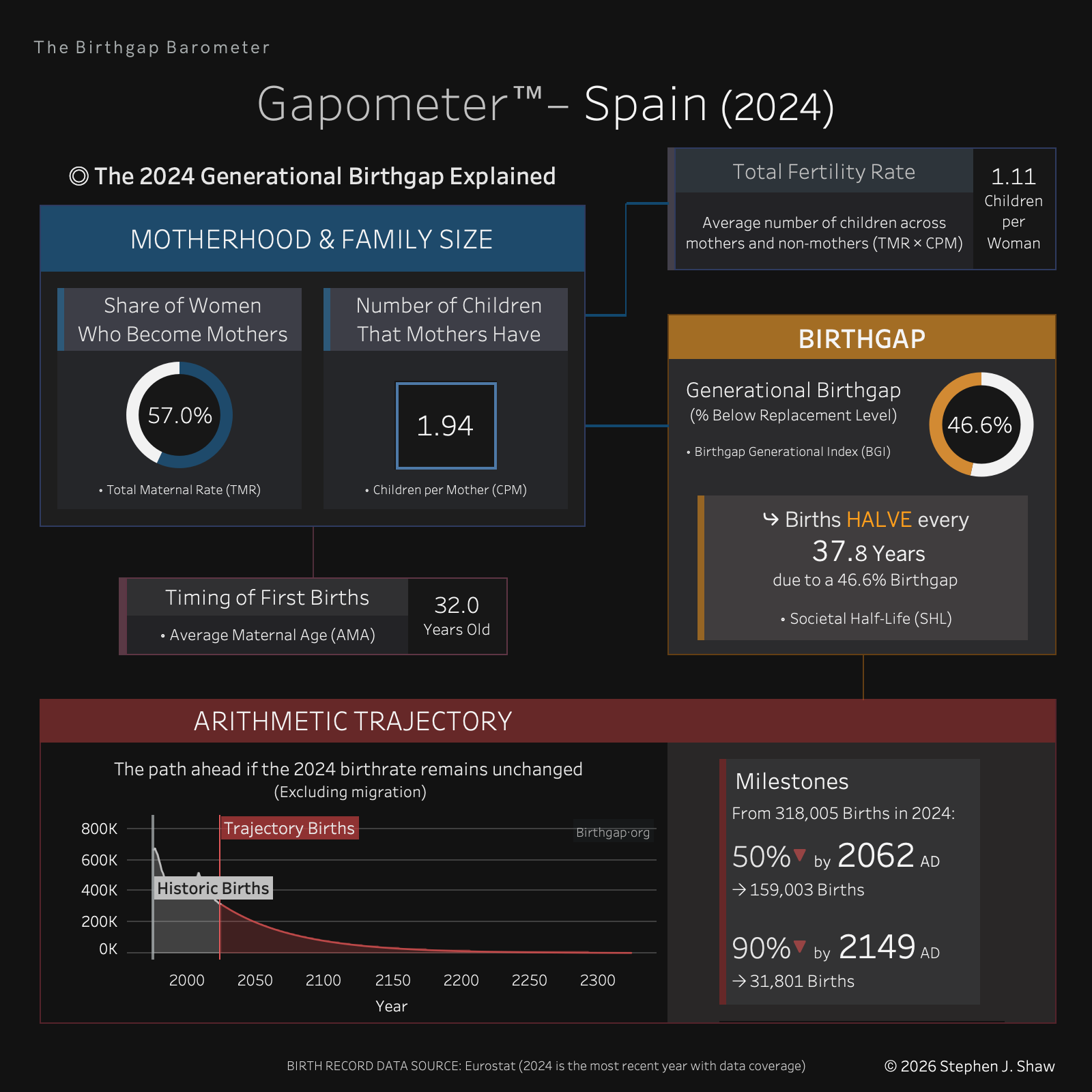
In 2024, Spain exhibits low fertility levels with stable birth metrics but continued declines over recent years and a notably aged maternal profile.
- Total maternal rate at 57.0%, among Europe's lowest (25/31)
- Children per mother at 1.94, ranking 4th lowest in Europe
- Mean maternal age high at 32.0 years, 2nd highest in Europe
- Birthgap generational indicator at 46.6%, one of Europe's highest (4/31)
- Childlessness rate elevated, ranking 7th highest in Europe
What Share of Women Become Mothers?(1/7)
Motherhood prevalence slightly declining over the past five years.
- 57.0% become mothers in 2024
- Down 0.2 points from the prior year
How Many Children Do Mothers Have?(2/7)
Children per mother show a modest upward trend recently.
- Mothers average 1.94 children in 2024
- Down 0.01 from the prior year
At What Age Do Women Become Mothers?(3/7)
Average maternal age continues to increase steadily.
- Average first-birth age is 32.0 in 2024
- Up 0.5 years from the prior year
What Share of Mothers Have Exactly One Child?(4/7)
Proportion of one-child families is gradually decreasing.
- 29.3% of mothers have one child in 2024
- Up 1.1 points from the prior year
What Share of Mothers Have Exactly Two Children?(5/7)
Two-child families are becoming slightly more common.
- 52.0% of mothers have two children in 2024
- Down 0.5 points from the prior year
What Share of Mothers Have Three or More Children?(6/7)
Families with three or more children are decreasing.
- 18.7% of mothers have three or more in 2024
- Down 0.6 points from the prior year
What Share of Women Remain Childless for Life?(7/7)
Childlessness rate has edged higher over five years.
- 43.0% remain childless in 2024
- Up 0.2 points from the prior year
How Low Are Overall Births?(1/6)
Birthgap generational indicator revealing a gradual rise.
- The birthgap stands at 46.6% in 2024
- Up 0.6 points from the prior year
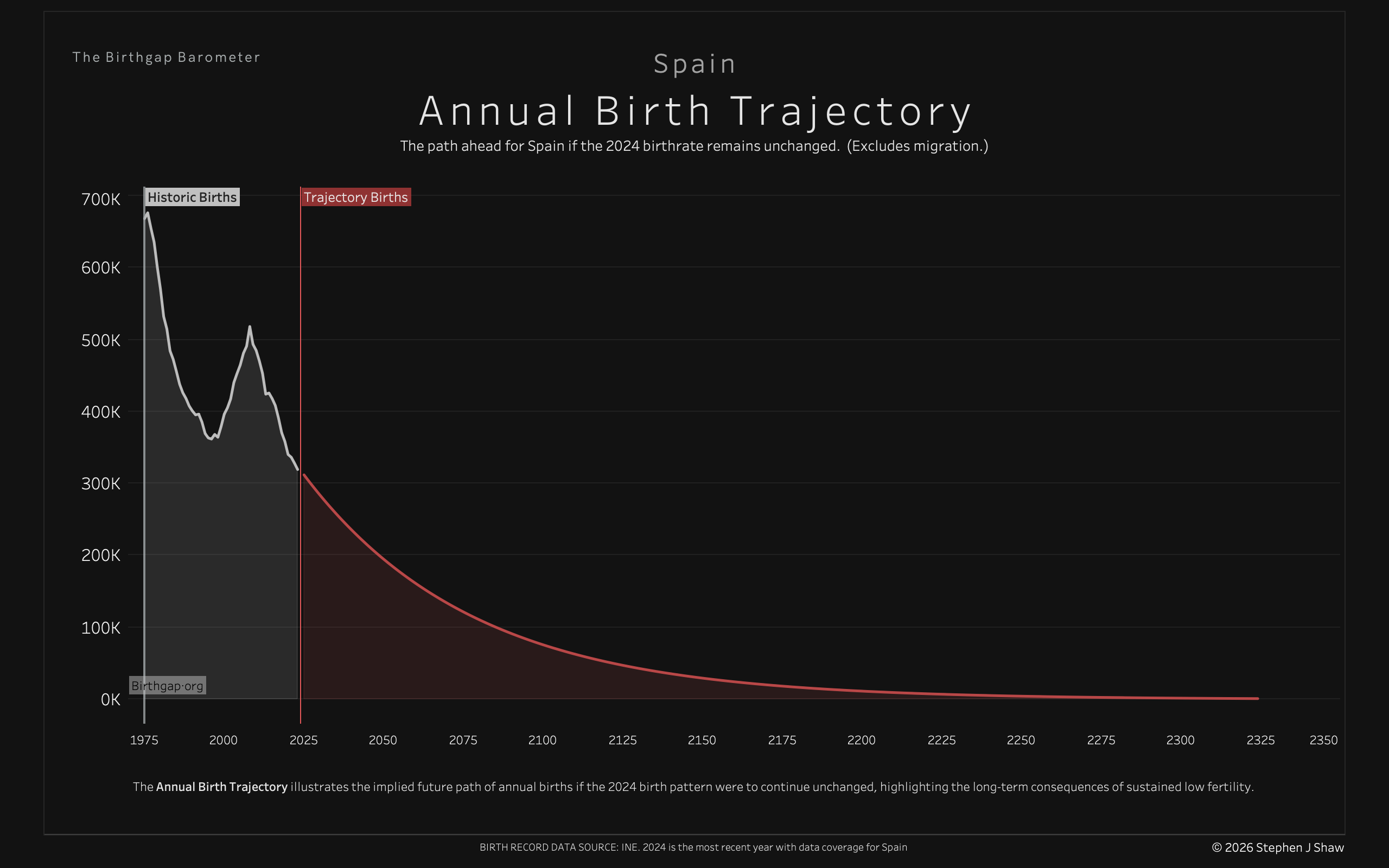
What is the Future Trajectory?(2/6)
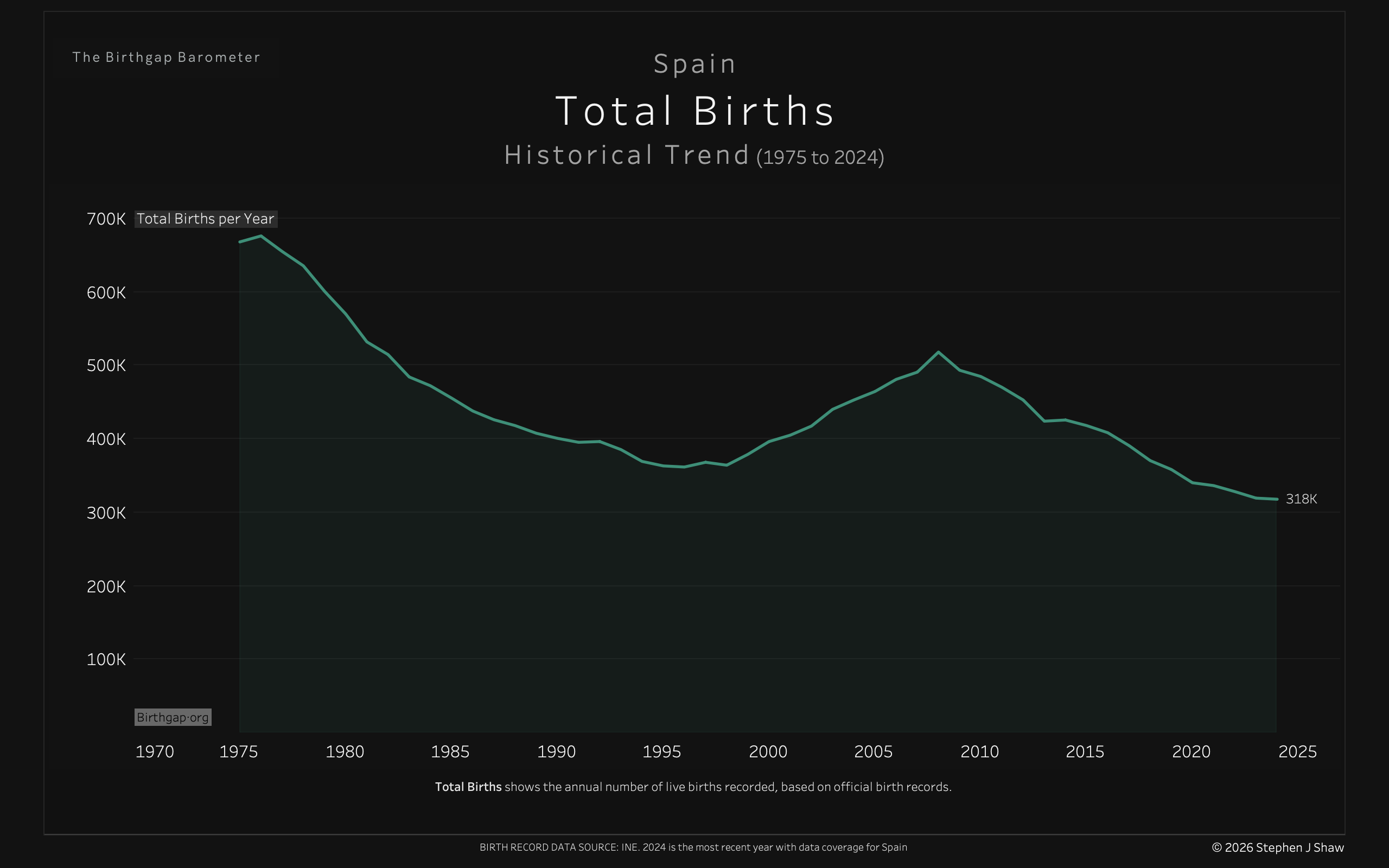
How Many Babies Are Born Each Year?(3/6)
Total births have been falling modestly in recent years.
- 318,005 births were recorded in 2024
- Down 1,518 from the prior year
How Do Births Compare to Future Retirees?(4/6)
Birthgap retirement indicator is experiencing a slow rise.
- The retiree birthgap stands at 59.9% in 2024
- Up 0.7 points from the prior year
How Fast Does One Generation Become Smaller?(5/6)
Where to Go Next(6/6)
For more detailed information, read the full Birthgap Country Report for Spain.
Read the Report →
 Netherlands
(1970–2024)
Netherlands
(1970–2024)
2024 Snapshot
Key Trends
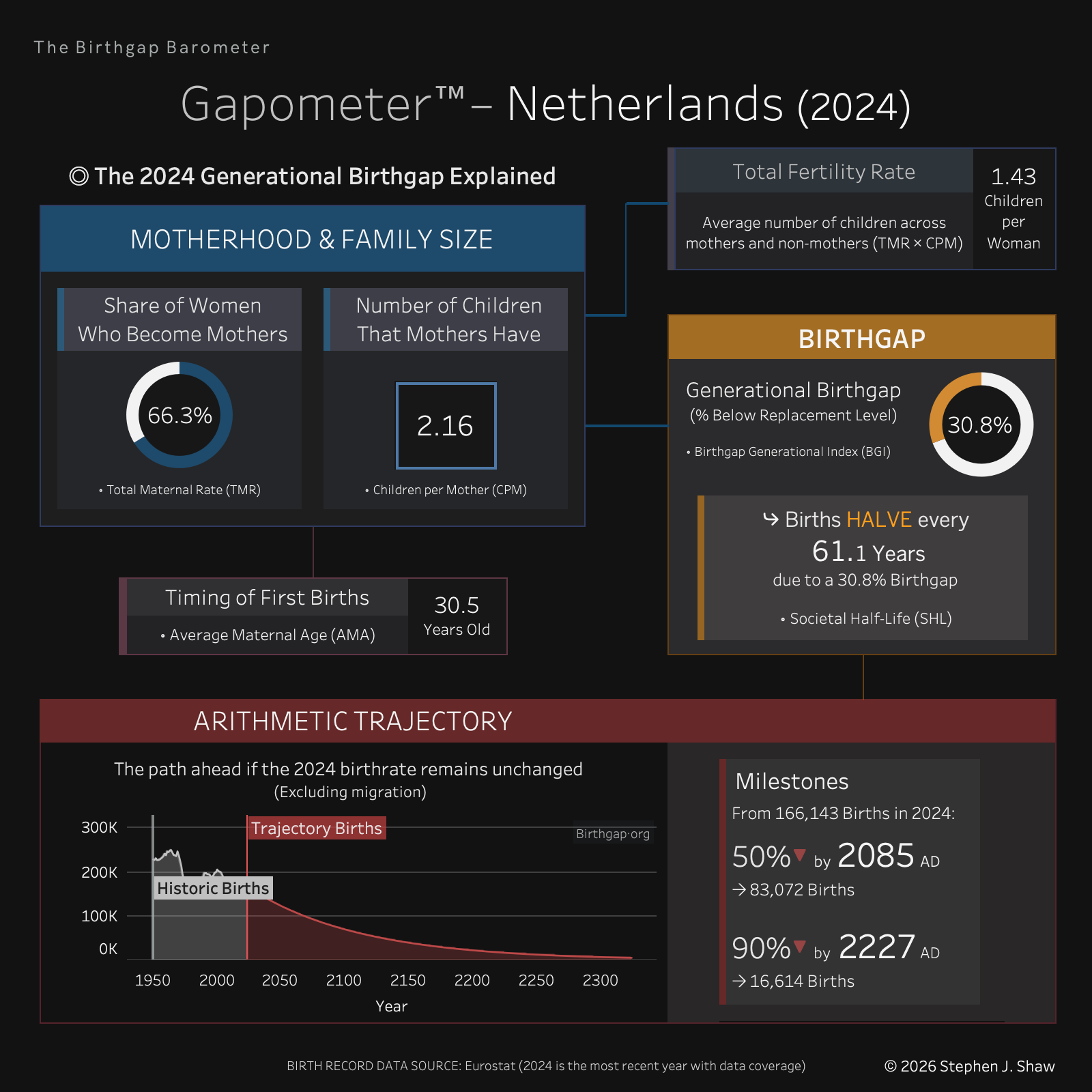
In 2024, Netherlands shows stable fertility trends with modest declines in birth rates and a slight increase in mean maternal age.
- Completed fertility remains steady at 66.3%, ranking 10th in Europe
- Children per mother total 2.16, slightly above the European average
- Mean age at childbearing rises to 30.4 years, 9th highest in Europe
- Generational birthgap persists with total fertility gap at 30.8%
- Lifetime childlessness holds near one-third of women, ranking 22nd in Europe
What Share of Women Become Mothers?(1/7)
Motherhood prevalence slightly decreases after recent small rise.
- 66.3% become mothers in 2024
- Up 0.3 points from the prior year
How Many Children Do Mothers Have?(2/7)
Average children per mother show a continued slow decline.
- Mothers average 2.16 children in 2024
- Down 0.02 from the prior year
At What Age Do Women Become Mothers?(3/7)
Average maternal age steadily rises, now above 30 years.
- Average first-birth age is 30.4 in 2024
- Up 0.1 years from the prior year
What Share of Mothers Have Exactly One Child?(4/7)
Proportion of one-child mothers continues to rise slowly.
- 21.0% of mothers have one child in 2024
- Up 0.4 points from the prior year
What Share of Mothers Have Exactly Two Children?(5/7)
Two-child motherhood is becoming more common in recent years.
- 53.4% of mothers have two children in 2024
- Up 0.6 points from the prior year
What Share of Mothers Have Three or More Children?(6/7)
Mothers with three or more children are becoming fewer.
- 25.7% of mothers have three or more in 2024
- Down 1.0 points from the prior year
What Share of Women Remain Childless for Life?(7/7)
Childlessness rate experiences a modest increase over five years.
- 33.7% remain childless in 2024
- Down 0.3 points from the prior year
How Low Are Overall Births?(1/6)
Birthgap generational indicator edges up gradually.
- The birthgap stands at 30.8% in 2024
- Up 0.4 points from the prior year
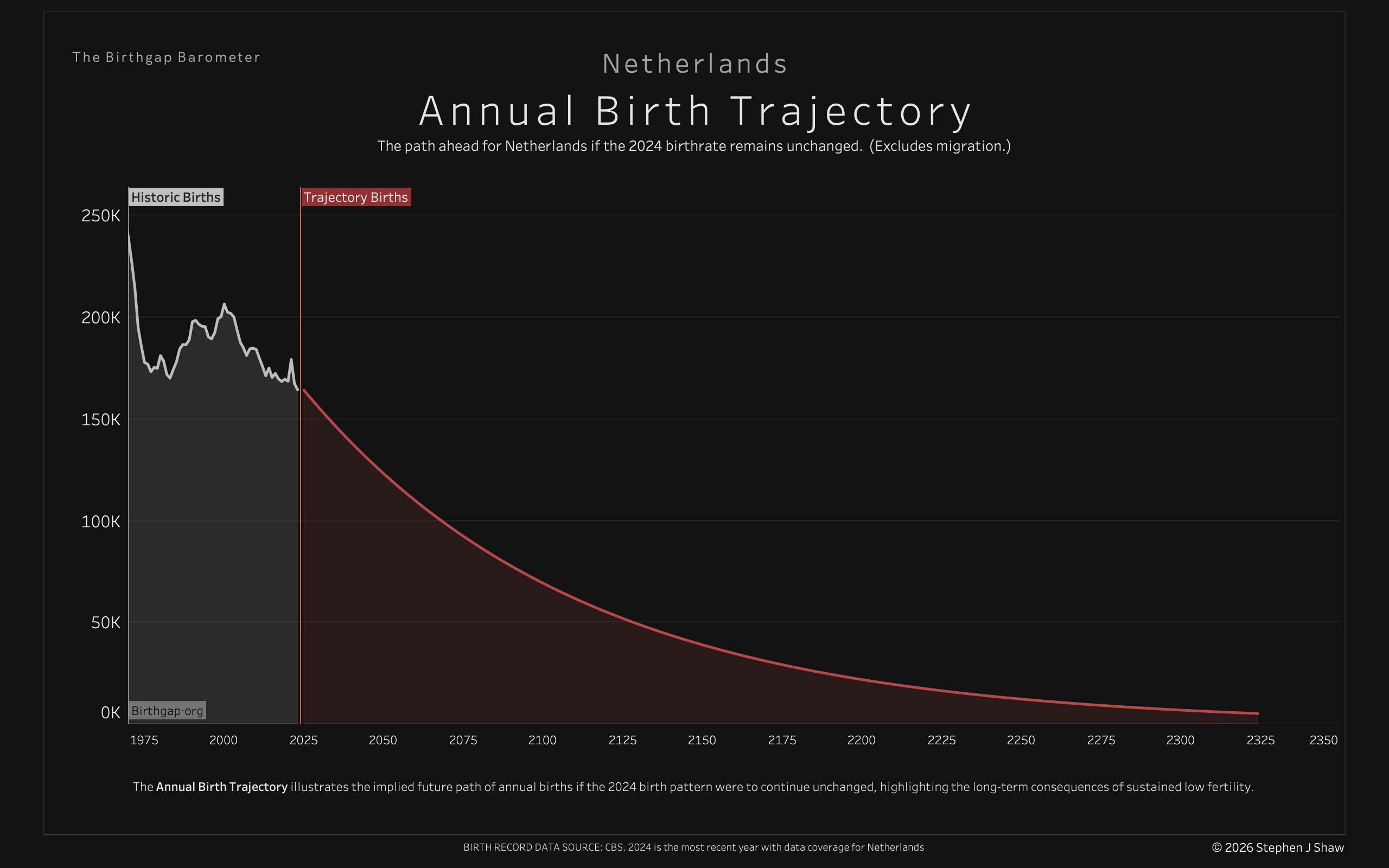
What is the Future Trajectory?(2/6)
How Many Babies Are Born Each Year?(3/6)
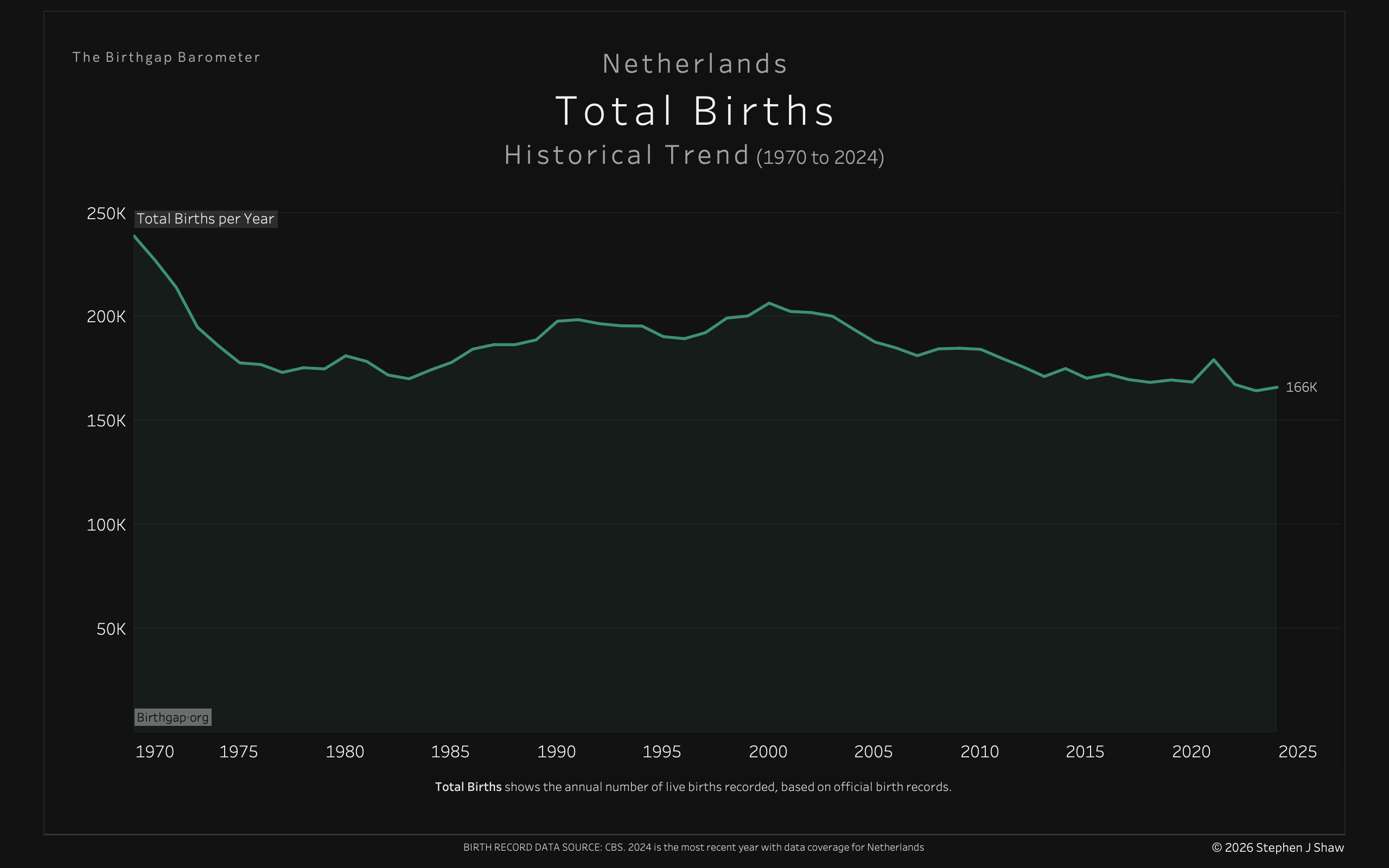
Total births show slight increase but overall downward trend.
- 166,143 births were recorded in 2024
- Up 1,695 from the prior year
How Do Births Compare to Future Retirees?(4/6)
Birthgap retirement indicator declines significantly over five years.
- The retiree birthgap stands at 25.8% in 2024
- Down 5.9 points from the prior year
How Fast Does One Generation Become Smaller?(5/6)
Where to Go Next(6/6)
For more detailed information, read the full Birthgap Country Report for Netherlands.
Read the Report →
 Portugal
(1970–2024)
Portugal
(1970–2024)
2024 Snapshot
Key Trends
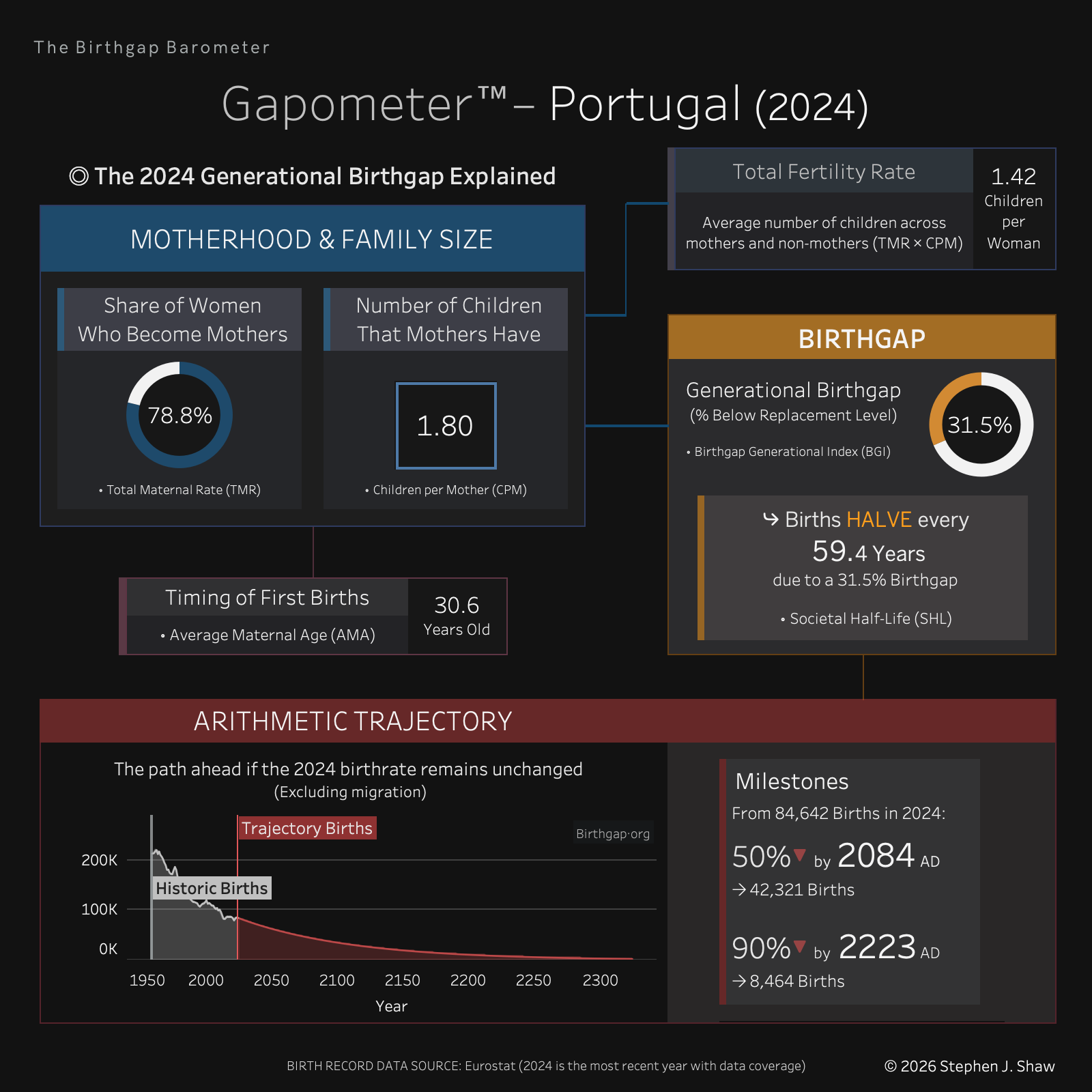
In 2024, Portugal showed a high total motherhood rate but the lowest children per mother in Europe, reflecting distinct fertility patterns.
- Second highest total motherhood rate globally and in Europe
- Lowest children per mother in Europe, ranked first lowest
- Average maternal age rising to 30.6 years, ranked 8th oldest in Europe
- Childlessness rate very low, among the lowest in Europe
- Societal half-life shortened compared to the 1970s, mid-ranking in Europe
What Share of Women Become Mothers?(1/7)
Motherhood prevalence remains stable at 0.788 with a rising trend.
- 78.8% become mothers in 2024
- Down 0.0 points from the prior year
How Many Children Do Mothers Have?(2/7)
Children per mother decline slightly to 1.80 over five years.
- Mothers average 1.80 children in 2024
- Down 0.04 from the prior year
At What Age Do Women Become Mothers?(3/7)
Average maternal age increases to 30.6 years in 2024.
- Average first-birth age is 30.6 in 2024
- Up 0.5 years from the prior year
What Share of Mothers Have Exactly One Child?(4/7)
Mothers having one child are becoming more common.
- 41.4% of mothers have one child in 2024
- Up 1.7 points from the prior year
What Share of Mothers Have Exactly Two Children?(5/7)
Two-child motherhood is slightly decreasing over recent years.
- 41.0% of mothers have two children in 2024
- Down 0.1 points from the prior year
What Share of Mothers Have Three or More Children?(6/7)
Fewer mothers have three or more children than before.
- 17.6% of mothers have three or more in 2024
- Down 1.6 points from the prior year
What Share of Women Remain Childless for Life?(7/7)
Childlessness rate holds steady but has been slowly falling.
- 21.2% remain childless in 2024
- Down 0.0 points from the prior year
How Low Are Overall Births?(1/6)
Birthgap generational indicator shows a modest rising trend.
- The birthgap stands at 31.5% in 2024
- Up 1.4 points from the prior year
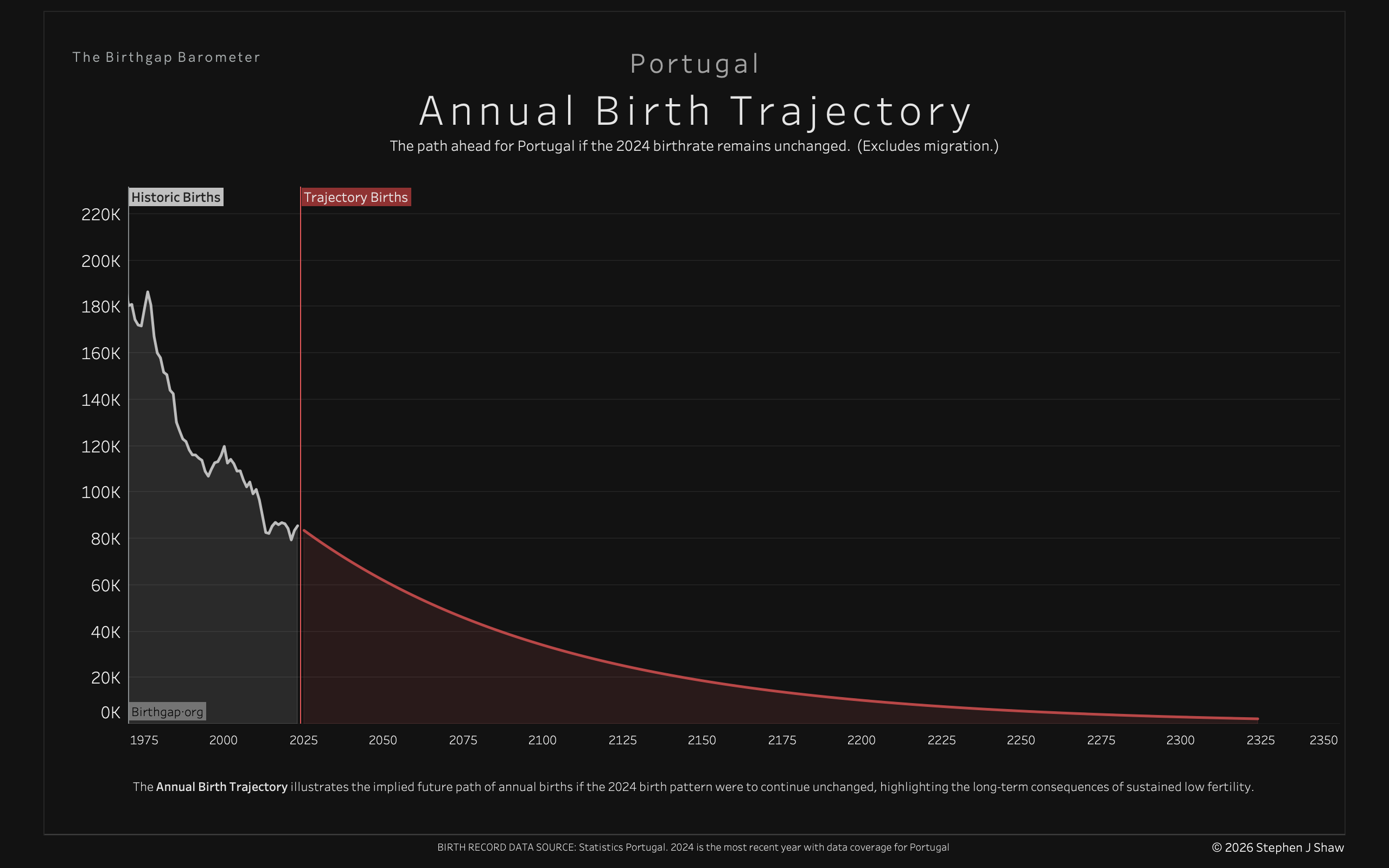
What is the Future Trajectory?(2/6)
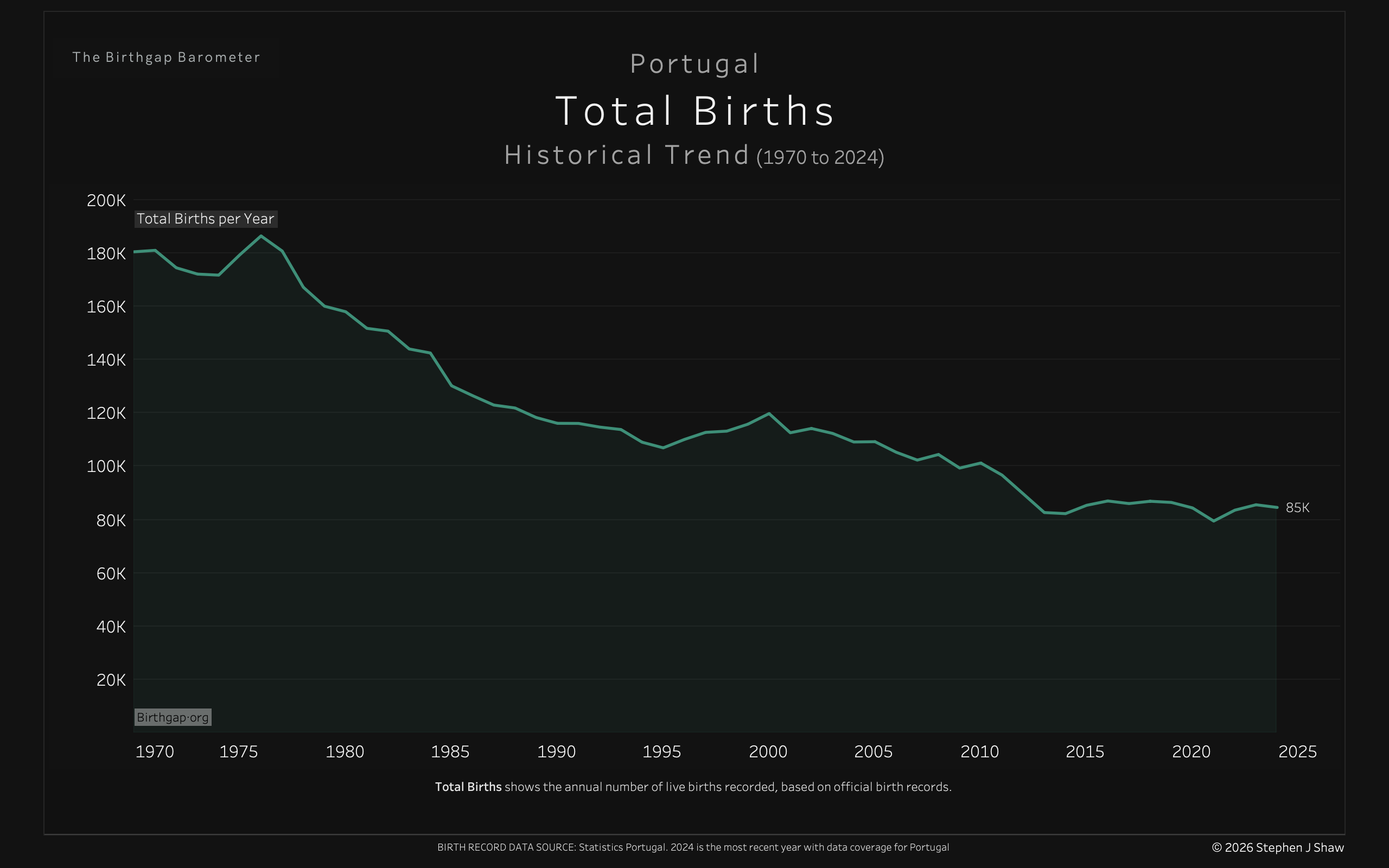
How Many Babies Are Born Each Year?(3/6)
Total births rise gradually, reaching 84,642 in 2024.
- 84,642 births were recorded in 2024
- Down 999 from the prior year
How Do Births Compare to Future Retirees?(4/6)
Birthgap retirement indicator continues a steady increase.
- The retiree birthgap stands at 47.0% in 2024
- Up 0.9 points from the prior year
How Fast Does One Generation Become Smaller?(5/6)
Where to Go Next(6/6)
For more detailed information, read the full Birthgap Country Report for Portugal.
Read the Report →
 Ireland
(1970–2024)
Ireland
(1970–2024)
2024 Snapshot
Key Trends
In 2024, Ireland's fertility and maternal age trends show slow declines in children per mother amid rising childlessness and an older average maternal age.
- Children per mother (2.3) among highest in Europe (27/31)
- Average maternal age 31.7 years, ranked 6th oldest in Europe
- Childlessness increasing, generational birthgap ongoing since 1992
- Stable total fertility gap lowest in Europe (27/31) indicating fewer births
- Strong survival life expectancy, ranked 4th longest in Europe
What Share of Women Become Mothers?(1/7)
Motherhood prevalence slightly decreases in the past five years.
- 64.3% become mothers in 2024
- Up 0.3 points from the prior year
How Many Children Do Mothers Have?(2/7)
Average children per mother show a small downward trend.
- Mothers average 2.30 children in 2024
- Down 0.05 from the prior year
At What Age Do Women Become Mothers?(3/7)
Average maternal age continues to increase by about half a year.
- Average first-birth age is 31.7 in 2024
- Down 0.4 years from the prior year
What Share of Mothers Have Exactly One Child?(4/7)
More mothers are having only one child recently.
- 19.2% of mothers have one child in 2024
- Up 2.2 points from the prior year
What Share of Mothers Have Exactly Two Children?(5/7)
Two-child families are becoming slightly less common.
- 43.5% of mothers have two children in 2024
- Up 0.5 points from the prior year
What Share of Mothers Have Three or More Children?(6/7)
Families with three or more children are declining.
- 37.3% of mothers have three or more in 2024
- Down 2.7 points from the prior year
What Share of Women Remain Childless for Life?(7/7)
Childlessness rate has increased slightly over five years.
- 35.7% remain childless in 2024
- Down 0.3 points from the prior year
How Low Are Overall Births?(1/6)
Generational birthgap indicator is gradually rising.
- The birthgap stands at 28.6% in 2024
- Up 1.2 points from the prior year
What is the Future Trajectory?(2/6)
How Many Babies Are Born Each Year?(3/6)
Total number of births shows a modest decrease this year.
- 54,062 births were recorded in 2024
- Down 355 from the prior year
How Do Births Compare to Future Retirees?(4/6)
Birthgap retirement indicator has risen in recent years.
- The retiree birthgap stands at 28.7% in 2024
- Up 1.4 points from the prior year
How Fast Does One Generation Become Smaller?(5/6)
Where to Go Next(6/6)
For more detailed information, read the full Birthgap Country Report for Ireland.
Read the Report →
 Sweden
(1970–2024)
Sweden
(1970–2024)
2024 Snapshot
Key Trends
In 2024, Sweden shows modest declines in fertility rates alongside a slightly aging maternal profile, with demographic shifts indicating ongoing population aging concerns.
- Completed fertility rate slightly below European average, ranked mid-range globally and in Europe
- Average children per mother decreasing gradually, positioned lower in global rankings
- Mean childbearing age slightly increasing, among older mean ages in Europe
- Birthgap generational indicator rising, indicating slower generational replacement
- Societal Half-Life significantly shorter than 1970s, ranking high globally indicating accelerated societal turnover
What Share of Women Become Mothers?(1/7)
Motherhood prevalence has slightly declined over five years.
- 64.2% become mothers in 2024
- Down 0.8 points from the prior year
How Many Children Do Mothers Have?(2/7)
Children per mother show a small decrease recently.
- Mothers average 2.23 children in 2024
- Down 0.00 from the prior year
At What Age Do Women Become Mothers?(3/7)
Average maternal age continues to rise steadily.
- Average first-birth age is 30.2 in 2024
- Up 0.2 years from the prior year
What Share of Mothers Have Exactly One Child?(4/7)
One-child motherhood has decreased marginally in recent years.
- 13.7% of mothers have one child in 2024
- Down 0.9 points from the prior year
What Share of Mothers Have Exactly Two Children?(5/7)
Two-child motherhood is becoming increasingly common.
- 56.5% of mothers have two children in 2024
- Up 0.6 points from the prior year
What Share of Mothers Have Three or More Children?(6/7)
Three-plus-child motherhood is slowly declining over time.
- 29.8% of mothers have three or more in 2024
- Up 0.3 points from the prior year
What Share of Women Remain Childless for Life?(7/7)
Childlessness rate is on a gradual upward trend.
- 35.8% remain childless in 2024
- Up 0.8 points from the prior year
How Low Are Overall Births?(1/6)
Birthgap generational indicator is gradually increasing.
- The birthgap stands at 30.8% in 2024
- Up 1.0 points from the prior year
What is the Future Trajectory?(2/6)
How Many Babies Are Born Each Year?(3/6)
Total births have decreased slightly in the latest year.
- 98,401 births were recorded in 2024
- Down 1,604 from the prior year
How Do Births Compare to Future Retirees?(4/6)
Birthgap retirement indicator shows a mild increase.
- The retiree birthgap stands at 26.1% in 2024
- Up 0.2 points from the prior year
How Fast Does One Generation Become Smaller?(5/6)
Where to Go Next(6/6)
For more detailed information, read the full Birthgap Country Report for Sweden.
Read the Report →
 Austria
(1984–2024)
Austria
(1984–2024)
2024 Snapshot
Key Trends
In 2024, Austria’s total maternal rate and children per mother show slight declines, with a rising average maternal age and increasing childlessness.
- Total maternal rate at 63.4%, slightly below Europe’s average, ranked 19th in Europe
- Children per mother steady at 2.06, ranking 12th in Europe
- Average maternal age increased to 30.4 years, 10th oldest in Europe
- Lifetime childlessness rose to 36.6%, ranking 13th in Europe
- Total fertility gap implies a 75% drop in great-grandchildren without migration
What Share of Women Become Mothers?(1/7)
Motherhood prevalence continues a slight downward trend in 2024.
- 63.4% become mothers in 2024
- Down 1.0 points from the prior year
How Many Children Do Mothers Have?(2/7)
Children per mother show a minor recent increase despite a five-year decline.
- Mothers average 2.06 children in 2024
- Up 0.02 from the prior year
At What Age Do Women Become Mothers?(3/7)
Average maternal age rises steadily, reaching 30.4 years in 2024.
- Average first-birth age is 30.4 in 2024
- Up 0.5 years from the prior year
What Share of Mothers Have Exactly One Child?(4/7)
Proportion of one-child mothers ticks down amid broader rise.
- 26.0% of mothers have one child in 2024
- Down 0.9 points from the prior year
What Share of Mothers Have Exactly Two Children?(5/7)
Two-child motherhood becomes increasingly common, nearing half of mothers.
- 49.7% of mothers have two children in 2024
- Up 0.3 points from the prior year
What Share of Mothers Have Three or More Children?(6/7)
Mothers with three or more children continue to decline slowly.
- 24.3% of mothers have three or more in 2024
- Up 0.6 points from the prior year
What Share of Women Remain Childless for Life?(7/7)
Childlessness rate climbs gradually, now surpassing 36%.
- 36.6% remain childless in 2024
- Up 1.0 points from the prior year
How Low Are Overall Births?(1/6)
Birthgap Generational Indicator edges slightly upward this year.
- The birthgap stands at 36.8% in 2024
- Up 0.3 points from the prior year
What is the Future Trajectory?(2/6)
How Many Babies Are Born Each Year?(3/6)
Total births fall slightly, totaling 77,238 in 2024.
- 77,238 births were recorded in 2024
- Down 333 from the prior year
How Do Births Compare to Future Retirees?(4/6)
Birthgap Retirement Indicator declines, reflecting shifts in generational replacement.
- The retiree birthgap stands at 35.6% in 2024
- Down 3.0 points from the prior year
How Fast Does One Generation Become Smaller?(5/6)
Where to Go Next(6/6)
For more detailed information, read the full Birthgap Country Report for Austria.
Read the Report →
 Denmark
(1970–2024)
Denmark
(1970–2024)
2024 Snapshot
Key Trends
In 2024, Denmark shows a moderately high maternal rate with a slightly declining trend, alongside one of Europe's oldest average childbearing ages.
- Total maternal rate ranks 13th in Europe, slightly above European average
- Mean age at childbearing among highest in Europe, over 6 years above 1970s
- Total fertility gap ranks low, indicating notable generational population decline
- Lifetime childlessness increasing, ranking in the lower third of European countries
What Share of Women Become Mothers?(1/7)
Motherhood prevalence is slightly declining this year.
- 64.9% become mothers in 2024
- Down 0.7 points from the prior year
How Many Children Do Mothers Have?(2/7)
Average children per mother continue to decrease.
- Mothers average 2.26 children in 2024
- Down 0.02 from the prior year
At What Age Do Women Become Mothers?(3/7)
Average maternal age has risen to just over 30 years.
- Average first-birth age is 30.3 in 2024
- Up 0.2 years from the prior year
What Share of Mothers Have Exactly One Child?(4/7)
Proportion of mothers with one child is falling.
- 11.6% of mothers have one child in 2024
- Up 1.5 points from the prior year
What Share of Mothers Have Exactly Two Children?(5/7)
Two-child families constitute the majority, slightly increasing.
- 60.0% of mothers have two children in 2024
- Down 1.5 points from the prior year
What Share of Mothers Have Three or More Children?(6/7)
Mothers with three or more children are marginally more common.
- 28.4% of mothers have three or more in 2024
- Up 0.0 points from the prior year
What Share of Women Remain Childless for Life?(7/7)
Childlessness rate shows a modest upward trend.
- 35.1% remain childless in 2024
- Up 0.7 points from the prior year
How Low Are Overall Births?(1/6)
Birthgap generational indicator is gradually increasing.
- The birthgap stands at 29.2% in 2024
- Up 1.5 points from the prior year
What is the Future Trajectory?(2/6)
How Many Babies Are Born Each Year?(3/6)
Total annual births have slightly declined recently.
- 57,064 births were recorded in 2024
- Down 387 from the prior year
How Do Births Compare to Future Retirees?(4/6)
Birthgap retirement indicator is on a slow rise.
- The retiree birthgap stands at 26.8% in 2024
- Down 2.5 points from the prior year
How Fast Does One Generation Become Smaller?(5/6)
Where to Go Next(6/6)
For more detailed information, read the full Birthgap Country Report for Denmark.
Read the Report →
 Norway
(1970–2024)
Norway
(1970–2024)
2024 Snapshot
Key Trends
In 2024, Norway shows modest population growth indicators amid declining fertility and aging trends.
- Total maternal rate (63.6%) near European average, ranked 18th in Europe
- Children per mother slightly high at 2.27, ranking 25th in Europe
- Average maternal age rising to 30.4 years, 12th oldest in Europe
- Lifetime childlessness at 36.4%, higher than European average, ranked 14th
- Significant birthgap implies sharp population decline over next centuries
What Share of Women Become Mothers?(1/7)
Motherhood prevalence has slightly decreased in recent years.
- 63.6% become mothers in 2024
- Up 0.8 points from the prior year
How Many Children Do Mothers Have?(2/7)
Average children per mother continue a gradual decline.
- Mothers average 2.27 children in 2024
- Up 0.03 from the prior year
At What Age Do Women Become Mothers?(3/7)
Average maternal age is steadily increasing, now over 30 years.
- Average first-birth age is 30.4 in 2024
- Up 0.1 years from the prior year
What Share of Mothers Have Exactly One Child?(4/7)
One-child motherhood prevalence is decreasing gradually.
- 12.2% of mothers have one child in 2024
- Down 1.0 points from the prior year
What Share of Mothers Have Exactly Two Children?(5/7)
Two-child motherhood is becoming more common over time.
- 55.9% of mothers have two children in 2024
- Down 1.1 points from the prior year
What Share of Mothers Have Three or More Children?(6/7)
Mothers with three or more children are becoming less frequent.
- 31.9% of mothers have three or more in 2024
- Up 2.1 points from the prior year
What Share of Women Remain Childless for Life?(7/7)
Childlessness rate is rising modestly over the past five years.
- 36.4% remain childless in 2024
- Down 0.8 points from the prior year
How Low Are Overall Births?(1/6)
Birthgap generational indicator shows a slight upward trend.
- The birthgap stands at 30.1% in 2024
- Down 1.7 points from the prior year
What is the Future Trajectory?(2/6)
How Many Babies Are Born Each Year?(3/6)
Total births have increased moderately in the latest year.
- 54,013 births were recorded in 2024
- Up 2,047 from the prior year
How Do Births Compare to Future Retirees?(4/6)
Birthgap retirement indicator has declined noticeably recently.
- The retiree birthgap stands at 27.6% in 2024
- Down 4.6 points from the prior year
How Fast Does One Generation Become Smaller?(5/6)
Where to Go Next(6/6)
For more detailed information, read the full Birthgap Country Report for Norway.
Read the Report →
 Finland
(1982–2024)
Finland
(1982–2024)
2024 Snapshot
Key Trends
In 2024, Finland shows low and declining fertility with aging mothers and high childlessness relative to European averages.
- Low completed fertility rates, ranked near bottom in Europe
- Mean age at childbearing rising, above European norm
- Childlessness among highest in Europe
- Declining births forecasted to drop sharply by 2170
- Family size shifting towards fewer children, more one-child mothers
What Share of Women Become Mothers?(1/7)
Motherhood prevalence shows a slight recent decline.
- 55.1% become mothers in 2024
- Down 0.3 points from the prior year
How Many Children Do Mothers Have?(2/7)
Average children per mother remains just above two.
- Mothers average 2.27 children in 2024
- Up 0.00 from the prior year
At What Age Do Women Become Mothers?(3/7)
Average maternal age continues to rise gradually.
- Average first-birth age is 30.0 in 2024
- Up 0.1 years from the prior year
What Share of Mothers Have Exactly One Child?(4/7)
Trend toward fewer one-child mothers reverses downward.
- 20.0% of mothers have one child in 2024
- Down 1.8 points from the prior year
What Share of Mothers Have Exactly Two Children?(5/7)
Rising share of mothers have two children.
- 50.6% of mothers have two children in 2024
- Up 2.1 points from the prior year
What Share of Mothers Have Three or More Children?(6/7)
Mothers with three or more children slightly decrease.
- 29.4% of mothers have three or more in 2024
- Down 0.4 points from the prior year
What Share of Women Remain Childless for Life?(7/7)
Childlessness rate is increasing slowly over five years.
- 44.9% remain childless in 2024
- Up 0.3 points from the prior year
How Low Are Overall Births?(1/6)
Birthgap generational indicator sees a small increase.
- The birthgap stands at 39.6% in 2024
- Up 0.3 points from the prior year
What is the Future Trajectory?(2/6)
How Many Babies Are Born Each Year?(3/6)
Total births decrease modestly despite recent rise.
- 43,655 births were recorded in 2024
- Up 311 from the prior year
How Do Births Compare to Future Retirees?(4/6)
Birthgap retirement indicator trends downward recently.
- The retiree birthgap stands at 27.1% in 2024
- Down 2.3 points from the prior year
How Fast Does One Generation Become Smaller?(5/6)
Where to Go Next(6/6)
For more detailed information, read the full Birthgap Country Report for Finland.
Read the Report →
 Belgium
(1990–2024)
Belgium
(1990–2024)
2024 Snapshot
Key Trends
In 2024, Belgium's fertility and family trends show modest declines in birth rates with stability in children per mother and a continued rise in mean childbearing age.
- Completed fertility at 66.6%, ranking 9th in Europe
- Children per mother steady at 2.17, above European average
- Mean age at childbearing rising to nearly 30 years
- Birthgap generational indicator low at 30.2%, ranking 23rd in Europe
- Shrinking total births forecasted to halve by 2085
What Share of Women Become Mothers?(1/7)
Motherhood prevalence has slightly declined over five years.
- 66.6% become mothers in 2024
- Down 1.3 points from the prior year
How Many Children Do Mothers Have?(2/7)
Average children per mother continues a subtle downward trend.
- Mothers average 2.17 children in 2024
- Down 0.00 from the prior year
At What Age Do Women Become Mothers?(3/7)
Maternal age steadily increases, nearing 30 years on average.
- Average first-birth age is 29.9 in 2024
- Up 0.1 years from the prior year
What Share of Mothers Have Exactly One Child?(4/7)
One-child motherhood keeps a slow upward trajectory.
- 24.8% of mothers have one child in 2024
- Down 0.1 points from the prior year
What Share of Mothers Have Exactly Two Children?(5/7)
Two-child motherhood is experiencing a slight decline.
- 47.7% of mothers have two children in 2024
- Up 0.7 points from the prior year
What Share of Mothers Have Three or More Children?(6/7)
Families with three or more children are becoming rarer.
- 27.6% of mothers have three or more in 2024
- Down 0.6 points from the prior year
What Share of Women Remain Childless for Life?(7/7)
Childlessness rate has been gradually increasing lately.
- 33.4% remain childless in 2024
- Up 1.3 points from the prior year
How Low Are Overall Births?(1/6)
Birthgap Generational Indicator shows a modest rise recently.
- The birthgap stands at 30.2% in 2024
- Up 1.4 points from the prior year
What is the Future Trajectory?(2/6)
How Many Babies Are Born Each Year?(3/6)
Total births have declined modestly in the past year.
- 108,150 births were recorded in 2024
- Down 2,529 from the prior year
How Do Births Compare to Future Retirees?(4/6)
Birthgap Retirement Indicator edges up slightly over five years.
- The retiree birthgap stands at 28.5% in 2024
- Down 0.3 points from the prior year
How Fast Does One Generation Become Smaller?(5/6)
Where to Go Next(6/6)
For more detailed information, read the full Birthgap Country Report for Belgium.
Read the Report →
 Switzerland
(1992–2024)
Switzerland
(1992–2024)
2024 Snapshot
Key Trends
In 2024, Switzerland shows stable children per mother but a rising average maternal age, with fertility rates slightly declining over recent years.
- Children per mother steady at 2.00, ranking 9th in Europe
- Average maternal age high at 31.8 years, 4th highest in Europe
- Total fertility growth rising, ranked 10th in Europe
- Shrinking support generation signals a 76% drop in great-grandchildren
- Births expected to fall by half by 2073 without migration
What Share of Women Become Mothers?(1/7)
Motherhood prevalence is declining gradually in recent years.
- 64.3% become mothers in 2024
- Down 1.6 points from the prior year
How Many Children Do Mothers Have?(2/7)
Average children per mother slightly decreased to around two.
- Mothers average 2.00 children in 2024
- Down 0.02 from the prior year
At What Age Do Women Become Mothers?(3/7)
Average maternal age continues to rise, nearing 32 years.
- Average first-birth age is 31.8 in 2024
- Up 0.5 years from the prior year
What Share of Mothers Have Exactly One Child?(4/7)
One-child motherhood is becoming more common.
- 24.5% of mothers have one child in 2024
- Up 1.0 points from the prior year
What Share of Mothers Have Exactly Two Children?(5/7)
Two-child families remain the most prevalent, rising slowly.
- 53.5% of mothers have two children in 2024
- Down 0.5 points from the prior year
What Share of Mothers Have Three or More Children?(6/7)
Families with three or more children are slightly declining.
- 22.0% of mothers have three or more in 2024
- Down 0.5 points from the prior year
What Share of Women Remain Childless for Life?(7/7)
Childlessness rates are increasing steadily over five years.
- 35.7% remain childless in 2024
- Up 1.6 points from the prior year
How Low Are Overall Births?(1/6)
Birthgap generational indicator shows a modest upward trend.
- The birthgap stands at 37.7% in 2024
- Up 2.0 points from the prior year
What is the Future Trajectory?(2/6)
How Many Babies Are Born Each Year?(3/6)
Total births have decreased modestly this year.
- 78,256 births were recorded in 2024
- Down 1,706 from the prior year
How Do Births Compare to Future Retirees?(4/6)
Birthgap retirement indicator shows a slight recent increase.
- The retiree birthgap stands at 35.1% in 2024
- Up 0.4 points from the prior year
How Fast Does One Generation Become Smaller?(5/6)
Where to Go Next(6/6)
For more detailed information, read the full Birthgap Country Report for Switzerland.
Read the Report →
 Croatia
(2001–2024)
Croatia
(2001–2024)
2024 Snapshot
Key Trends
In 2024, Croatia shows stable birth and fertility patterns with slightly rising mean age at childbearing and some of the highest total fertility rates in Europe.
- Total fertility rate ranks 6th highest in Europe
- Children per mother stable around 2.15, ranking 16th in Europe
- Mean age at childbearing increased to nearly 30 years, 17th in Europe
- Low lifetime childlessness rate, ranked 26th in Europe
- Strong birthrate ranking 14th in Europe despite recent declines
What Share of Women Become Mothers?(1/7)
Motherhood prevalence slightly rising to 0.678 in 2024.
- 67.8% become mothers in 2024
- Up 0.4 points from the prior year
How Many Children Do Mothers Have?(2/7)
Children per mother mildly decreased to 2.15 over five years.
- Mothers average 2.15 children in 2024
- Up 0.01 from the prior year
At What Age Do Women Become Mothers?(3/7)
Average maternal age increased to nearly 30 years in 2024.
- Average first-birth age is 29.8 in 2024
- Up 0.1 years from the prior year
What Share of Mothers Have Exactly One Child?(4/7)
Proportion of one-child mothers declining gradually.
- 24.5% of mothers have one child in 2023
- Up 0.6 points from the prior year
What Share of Mothers Have Exactly Two Children?(5/7)
Two-child motherhood is currently the most common and rising.
- 47.2% of mothers have two children in 2023
- Up 0.1 points from the prior year
What Share of Mothers Have Three or More Children?(6/7)
Three-plus-child families are decreasing in prevalence.
- 28.3% of mothers have three or more in 2023
- Down 0.7 points from the prior year
What Share of Women Remain Childless for Life?(7/7)
Childlessness rate is falling, now at 32.2% in 2024.
- 32.2% remain childless in 2024
- Down 0.4 points from the prior year
How Low Are Overall Births?(1/6)
Birthgap generational indicator edged down but shows upward trend.
- The birthgap stands at 29.5% in 2024
- Down 0.6 points from the prior year
What is the Future Trajectory?(2/6)
How Many Babies Are Born Each Year?(3/6)
Total births slightly declined to just over 32,000 in 2024.
- 32,069 births were recorded in 2024
- Up 260 from the prior year
How Do Births Compare to Future Retirees?(4/6)
Birthgap retirement indicator shows a small rise despite recent drop.
- The retiree birthgap stands at 37.7% in 2024
- Down 0.5 points from the prior year
How Fast Does One Generation Become Smaller?(5/6)
Where to Go Next(6/6)
For more detailed information, read the full Birthgap Country Report for Croatia.
Read the Report →
 Turkey
(2018–2024)
Turkey
(2018–2024)
2024 Snapshot
Key Trends
In 2024, Turkey shows a notably high children per mother rate but low maternal age and modest fertility retention compared to European averages.
- Highest children per mother in Europe (2.38)
- One of the lowest mean ages at childbearing in Europe (27.3 years)
- Total fertility completion below European average (62%)
- Rising lifetime childlessness rate, ranking 11th lowest in Europe
- Births projected to halve by 2084 under current trends
What Share of Women Become Mothers?(1/7)
Motherhood prevalence continues to decline gradually in 2024.
- 62.0% become mothers in 2024
- Up 2.4 points from the prior year
How Many Children Do Mothers Have?(2/7)
Average children per mother decreased to 2.39 in 2024.
- Mothers average 2.38 children in 2024
- Down 0.15 from the prior year
At What Age Do Women Become Mothers?(3/7)
Average maternal age is steadily increasing, reaching 27.3 years.
- Average first-birth age is 27.3 in 2024
- Up 0.3 years from the prior year
What Share of Mothers Have Exactly One Child?(4/7)
Proportion of one-child mothers is noticeably increasing.
- 27.5% of mothers have one child in 2024
- Up 7.9 points from the prior year
What Share of Mothers Have Exactly Two Children?(5/7)
Two-child motherhood remains the most common but slightly fell.
- 34.2% of mothers have two children in 2024
- Down 0.4 points from the prior year
What Share of Mothers Have Three or More Children?(6/7)
Mothers with three or more children continue to decline.
- 38.2% of mothers have three or more in 2024
- Down 7.5 points from the prior year
What Share of Women Remain Childless for Life?(7/7)
Childlessness rate is rising despite other fertility declines.
- 38.0% remain childless in 2024
- Down 2.4 points from the prior year
How Low Are Overall Births?(1/6)
Birth interval generational indicator shows a slight upward trend.
- The birthgap stands at 28.6% in 2024
- Up 1.5 points from the prior year
What is the Future Trajectory?(2/6)
How Many Babies Are Born Each Year?(3/6)
Total births fell below 940,000, continuing a downward trend.
- 937,559 births were recorded in 2024
- Down 24,007 from the prior year
How Do Births Compare to Future Retirees?(4/6)
Birthgap retirement indicator is increasing, indicating demographic shifts.
- The retiree birthgap stands at 18.8% in 2024
- Up 5.8 points from the prior year
How Fast Does One Generation Become Smaller?(5/6)
Where to Go Next(6/6)
For more detailed information, read the full Birthgap Country Report for Turkey.
Read the Report →
 Poland
(1971–2024)
Poland
(1971–2024)
2024 Snapshot
Key Trends
In 2024, Poland's fertility rates remain low with continuing declines in births and high childlessness, reflecting persistent demographic challenges since the early 1990s.
- One of the lowest completed fertility rates globally and in Europe
- Ranks 5th highest in generational birthgap, signaling deep fertility decline
- Mean age at childbearing steadily rising, now above 29 years
- Childlessness among women ranks 3rd highest in Europe
- Societal half-life notably short, indicating rapid generational turnover
What Share of Women Become Mothers?(1/7)
Motherhood prevalence is declining steadily in recent years.
- 52.6% become mothers in 2024
- Down 3.4 points from the prior year
How Many Children Do Mothers Have?(2/7)
Average children per mother continue a gradual downward trend.
- Mothers average 2.07 children in 2024
- Down 0.04 from the prior year
At What Age Do Women Become Mothers?(3/7)
Average maternal age shows a slow but steady increase.
- Average first-birth age is 29.4 in 2024
- Up 0.2 years from the prior year
What Share of Mothers Have Exactly One Child?(4/7)
Proportion of one-child mothers is on a slight upward trajectory.
- 23.1% of mothers have one child in 2024
- Down 2.2 points from the prior year
What Share of Mothers Have Exactly Two Children?(5/7)
Two-child motherhood is increasing, now nearly half of families.
- 49.3% of mothers have two children in 2024
- Up 7.6 points from the prior year
What Share of Mothers Have Three or More Children?(6/7)
Fewer mothers have three or more children than five years ago.
- 27.7% of mothers have three or more in 2024
- Down 5.3 points from the prior year
What Share of Women Remain Childless for Life?(7/7)
Childlessness rate is climbing, indicating more women remain childfree.
- 47.4% remain childless in 2024
- Up 3.4 points from the prior year
How Low Are Overall Births?(1/6)
Birthgap generational indicator rising, signaling changing family patterns.
- The birthgap stands at 47.5% in 2024
- Up 4.6 points from the prior year
What is the Future Trajectory?(2/6)
How Many Babies Are Born Each Year?(3/6)
Total births have decreased notably compared to previous years.
- 251,800 births were recorded in 2024
- Down 20,541 from the prior year
How Do Births Compare to Future Retirees?(4/6)
Birthgap retirement indicator shows a rising trend, affecting future demographics.
- The retiree birthgap stands at 50.9% in 2024
- Up 5.9 points from the prior year
How Fast Does One Generation Become Smaller?(5/6)
Where to Go Next(6/6)
For more detailed information, read the full Birthgap Country Report for Poland.
Read the Report →
 Hungary
(1970–2024)
Hungary
(1970–2024)
2024 Snapshot
Key Trends
In 2024, Hungary's maternal and fertility metrics highlight ongoing demographic challenges with declines in total maternal rate and births, alongside rising childlessness.
- Total maternal rate fell sharply, ranking 20th in Europe
- Average children per mother rising slightly, near historical levels
- Maternal age at birth increased, now below European average
- High lifetime childlessness rate, among the highest in Europe
- Birthgap Retirement Indicator notably elevated, ranking 10th in Europe
What Share of Women Become Mothers?(1/7)
Motherhood prevalence continues to decline in 2024.
- 62.5% become mothers in 2024
- Down 6.3 points from the prior year
How Many Children Do Mothers Have?(2/7)
Children per mother shows a slight increase this year.
- Mothers average 2.18 children in 2024
- Up 0.02 from the prior year
At What Age Do Women Become Mothers?(3/7)
Average maternal age rises to nearly 29 and a half years.
- Average first-birth age is 29.4 in 2024
- Up 0.2 years from the prior year
What Share of Mothers Have Exactly One Child?(4/7)
Proportion of one-child mothers slightly decreases in 2024.
- 25.6% of mothers have one child in 2024
- Down 0.6 points from the prior year
What Share of Mothers Have Exactly Two Children?(5/7)
Two-child motherhood remains the most common family size.
- 44.3% of mothers have two children in 2024
- Down 0.3 points from the prior year
What Share of Mothers Have Three or More Children?(6/7)
Three-plus-child motherhood is gradually becoming more frequent.
- 30.1% of mothers have three or more in 2024
- Up 0.9 points from the prior year
What Share of Women Remain Childless for Life?(7/7)
Childlessness rate is steadily climbing over recent years.
- 37.5% remain childless in 2024
- Up 6.3 points from the prior year
How Low Are Overall Births?(1/6)
Birthgap generational indicator noticeably increasing over five years.
- The birthgap stands at 34.2% in 2024
- Up 5.9 points from the prior year
What is the Future Trajectory?(2/6)
How Many Babies Are Born Each Year?(3/6)
Total births have dropped by nearly seven thousand this year.
- 77,511 births were recorded in 2024
- Down 6,886 from the prior year
How Do Births Compare to Future Retirees?(4/6)
Birthgap retirement indicator shows a continuing upward trend.
- The retiree birthgap stands at 46.8% in 2024
- Up 5.7 points from the prior year
How Fast Does One Generation Become Smaller?(5/6)
Where to Go Next(6/6)
For more detailed information, read the full Birthgap Country Report for Hungary.
Read the Report →
 Greece
(1992–2024)
Greece
(1992–2024)
2024 Snapshot
Key Trends
In 2024, Greece's maternal and fertility measures show stability with modest declines in total births and a persistently high average maternal age.
- Total maternal rate steady around 60%, ranked 26th globally among 38 countries
- Average maternal age high at nearly 32 years, 6th highest worldwide
- Lifetime childlessness rate stable near 40%, ranks 13th globally
- Two-child families declining, one-child families increasing moderately
- Future birth projections indicate a significant decline by late 21st century
What Share of Women Become Mothers?(1/7)
Motherhood prevalence continues a slight downward trend.
- 60.0% become mothers in 2024
- Down 0.4 points from the prior year
How Many Children Do Mothers Have?(2/7)
Average children per mother decreasing slowly.
- Mothers average 2.04 children in 2024
- Down 0.02 from the prior year
At What Age Do Women Become Mothers?(3/7)
Average maternal age rising gradually, now over 31 years.
- Average first-birth age is 31.7 in 2024
- Up 0.0 years from the prior year
What Share of Mothers Have Exactly One Child?(4/7)
One-child motherhood is becoming more common.
- 23.3% of mothers have one child in 2024
- Up 2.1 points from the prior year
What Share of Mothers Have Exactly Two Children?(5/7)
Two-child families are declining in prevalence.
- 53.7% of mothers have two children in 2024
- Down 1.5 points from the prior year
What Share of Mothers Have Three or More Children?(6/7)
Mothers with three or more children are decreasing.
- 23.1% of mothers have three or more in 2024
- Down 0.6 points from the prior year
What Share of Women Remain Childless for Life?(7/7)
Childlessness rate is slightly increasing over recent years.
- 40.0% remain childless in 2024
- Up 0.4 points from the prior year
How Low Are Overall Births?(1/6)
Birthgap generational indicator shows a modest increase.
- The birthgap stands at 40.7% in 2024
- Up 0.9 points from the prior year
What is the Future Trajectory?(2/6)
How Many Babies Are Born Each Year?(3/6)
Total births have declined modestly over the past five years.
- 68,467 births were recorded in 2024
- Down 2,436 from the prior year
How Do Births Compare to Future Retirees?(4/6)
Retirement-age birthgap indicator showing a steady rise.
- The retiree birthgap stands at 54.9% in 2023
- Up 2.8 points from the prior year
How Fast Does One Generation Become Smaller?(5/6)
Where to Go Next(6/6)
For more detailed information, read the full Birthgap Country Report for Greece.
Read the Report →
 Russia
(1970–2024)
Russia
(1970–2024)
2024 Snapshot
What Share of Women Become Mothers?(1/7)
Birthrates continue to remain low.
How Many Children Do Mothers Have?(2/7)
Birthrates continue to remain low.
At What Age Do Women Become Mothers?(3/7)
Birthrates continue to remain low.
What Share of Mothers Have Exactly One Child?(4/7)
Birthrates continue to remain low.
What Share of Mothers Have Exactly Two Children?(5/7)
Birthrates continue to remain low.
What Share of Mothers Have Three or More Children?(6/7)
Birthrates continue to remain low.
What Share of Women Remain Childless for Life?(7/7)
Birthrates continue to remain low.
How Low Are Overall Births?(1/6)
Birthrates continue to remain low.
What is the Future Trajectory?(2/6)
How Many Babies Are Born Each Year?(3/6)
Birthrates continue to remain low.
How Do Births Compare to Future Retirees?(4/6)
Birthrates continue to remain low.
How Fast Does One Generation Become Smaller?(5/6)
Where to Go Next(6/6)
For more detailed information, read the full Birthgap Country Report for Russia.
Read the Report →
 Ukraine
(1970–2021)
Ukraine
(1970–2021)
2021 Snapshot
Key Trends
In 2021, Ukraine experienced some of the lowest fertility and maternal age indicators in Europe, reflecting long-term declines and demographic shifts since the 1970s.
- Lowest total maternal rate (TMR) in Europe, lowest globally among 38 countries
- Lowest average maternal age at birth in Europe and globally
- Fertility at 1.83 children per mother, below European average
- Highest birthgap generational indicator (TFG) decline globally and in Europe
- Shortest societal half-life (SHL) in Europe and worldwide
What Share of Women Become Mothers?(1/7)
Motherhood prevalence has slightly declined over five years.
- 63.4% become mothers in 2021
- Down 2.2 points from the prior year
How Many Children Do Mothers Have?(2/7)
Average children per mother continue a gradual decline.
- Mothers average 1.83 children in 2021
- Down 0.03 from the prior year
At What Age Do Women Become Mothers?(3/7)
Average maternal age is slowly increasing.
- Average first-birth age is 25.7 in 2021
- Up 0.2 years from the prior year
What Share of Mothers Have Exactly One Child?(4/7)
One-child motherhood rates have been decreasing slightly.
- 22.7% of mothers have one child in 2013
- Down 2.3 points from the prior year
What Share of Mothers Have Exactly Two Children?(5/7)
Two-child motherhood prevalence shows a modest increase.
- 54.1% of mothers have two children in 2013
- Up 0.8 points from the prior year
What Share of Mothers Have Three or More Children?(6/7)
Three or more children per mother is increasingly common.
- 23.2% of mothers have three or more in 2013
- Up 1.4 points from the prior year
What Share of Women Remain Childless for Life?(7/7)
Childlessness rate is gradually rising over recent years.
- 36.6% remain childless in 2021
- Up 2.2 points from the prior year
How Low Are Overall Births?(1/6)
Generational birthgap indicator is experiencing a mild rise.
- The birthgap stands at 44.0% in 2021
- Up 2.8 points from the prior year
What is the Future Trajectory?(2/6)
How Many Babies Are Born Each Year?(3/6)
Total births have decreased steadily in recent years.
- 273,772 births were recorded in 2021
- Down 19,685 from the prior year
How Do Births Compare to Future Retirees?(4/6)
Birthgap retirement indicator experienced a notable fall.
- The retiree birthgap stands at 29.6% in 2014
- Up 3.3 points from the prior year
How Fast Does One Generation Become Smaller?(5/6)
Where to Go Next(6/6)
For more detailed information, read the full Birthgap Country Report for Ukraine.
Read the Report →
 Estonia
(1970–2024)
Estonia
(1970–2024)
2024 Snapshot
Key Trends
In 2024, Estonia shows low maternal rates and high childlessness, with distinct demographic shifts shaping its future population dynamics.
- Lowest total maternal rate in Europe, ranked 31/31
- Highest childlessness rate in Europe, ranked 1/31
- Above-average children per mother (2.27) but declining
- Mean age at childbearing slightly below European average
- One of Europe's highest Birthgap generational drops, ranked 5/31
What Share of Women Become Mothers?(1/7)
Motherhood prevalence continues to decline through 2024.
- 51.9% become mothers in 2024
- Down 3.7 points from the prior year
How Many Children Do Mothers Have?(2/7)
Average children per mother fell slightly to 2.27.
- Mothers average 2.27 children in 2024
- Down 0.07 from the prior year
At What Age Do Women Become Mothers?(3/7)
Average maternal age decreased to 28.9 years in 2024.
- Average first-birth age is 28.9 in 2024
- Down 0.7 years from the prior year
What Share of Mothers Have Exactly One Child?(4/7)
Proportion of one-child mothers rises modestly in 2023.
- 14.5% of mothers have one child in 2023
- Down 0.5 points from the prior year
What Share of Mothers Have Exactly Two Children?(5/7)
Two-child motherhood remains the most common family size.
- 39.5% of mothers have two children in 2023
- Up 0.1 points from the prior year
What Share of Mothers Have Three or More Children?(6/7)
Three-plus-child families show a slight fall in 2023.
- 46.0% of mothers have three or more in 2023
- Up 0.4 points from the prior year
What Share of Women Remain Childless for Life?(7/7)
Childlessness rate increased over the last five years.
- 48.1% remain childless in 2024
- Up 3.7 points from the prior year
How Low Are Overall Births?(1/6)
Birthgap generational indicator shows a rising trend.
- The birthgap stands at 43.0% in 2024
- Up 5.9 points from the prior year
What is the Future Trajectory?(2/6)
How Many Babies Are Born Each Year?(3/6)
Total births dropped by over 1,200 in 2024.
- 9,690 births were recorded in 2024
- Down 1,254 from the prior year
How Do Births Compare to Future Retirees?(4/6)
Birthgap retirement indicator is steadily increasing in recent years.
- The retiree birthgap stands at 47.6% in 2024
- Up 5.7 points from the prior year
How Fast Does One Generation Become Smaller?(5/6)
Where to Go Next(6/6)
For more detailed information, read the full Birthgap Country Report for Estonia.
Read the Report →
 Latvia
(2000–2024)
Latvia
(2000–2024)
2024 Snapshot
Key Trends
In 2024, Latvia shows demographic contrasts with low maternal age and fertility levels amid high childlessness and declining birth rates.
- Children per mother stable above global average at 2.29
- One of Europe's lowest average maternal ages (28.1 years)
- Childlessness rate very high, ranked 2nd in Europe
- Total fertility gap ranks 7th highest in Europe
- Strong projected birth declines up to 90% by 2151
What Share of Women Become Mothers?(1/7)
Motherhood prevalence has declined over the past five years.
- 52.4% become mothers in 2024
- Down 4.8 points from the prior year
How Many Children Do Mothers Have?(2/7)
Average children per mother show a downward trend recently.
- Mothers average 2.29 children in 2024
- Down 0.05 from the prior year
At What Age Do Women Become Mothers?(3/7)
Average maternal age is decreasing after previous rises.
- Average first-birth age is 28.1 in 2024
- Down 0.8 years from the prior year
What Share of Mothers Have Exactly One Child?(4/7)
Proportion of mothers with one child is increasing.
- 10.1% of mothers have one child in 2023
- Up 6.9 points from the prior year
What Share of Mothers Have Exactly Two Children?(5/7)
Mothers with two children have become less common.
- 46.2% of mothers have two children in 2023
- Down 4.6 points from the prior year
What Share of Mothers Have Three or More Children?(6/7)
Mothers with three or more children are slightly more frequent.
- 43.6% of mothers have three or more in 2023
- Down 2.3 points from the prior year
What Share of Women Remain Childless for Life?(7/7)
Childlessness rate in women is rising recently.
- 47.6% remain childless in 2024
- Up 4.8 points from the prior year
How Low Are Overall Births?(1/6)
Generational birthgap indicator is increasing steadily this year.
- The birthgap stands at 42.0% in 2024
- Up 6.6 points from the prior year
What is the Future Trajectory?(2/6)
How Many Babies Are Born Each Year?(3/6)
Total births have dropped notably in the latest year.
- 12,887 births were recorded in 2024
- Down 1,591 from the prior year
How Do Births Compare to Future Retirees?(4/6)
Birthgap retirement indicator continues an upward trend.
- The retiree birthgap stands at 49.9% in 2024
- Up 4.8 points from the prior year
How Fast Does One Generation Become Smaller?(5/6)
Where to Go Next(6/6)
For more detailed information, read the full Birthgap Country Report for Latvia.
Read the Report →
 Lithuania
(1970–2024)
Lithuania
(1970–2024)
2024 Snapshot
Key Trends
In 2024, Lithuania shows a continuing downward trend in fertility with total maternal and children per mother rates below European averages, alongside rising childlessness.
- Total maternal rate among lowest in Europe (28/31) and globally (33/38)
- Children per mother is low, ranking 6th lowest in Europe
- Childlessness rate is high, 4th highest in Europe and 6th globally
- Shorter generational lifespan, ranking 30/31 in Europe
- Projected births decline up to 90% by 2134 with shrinking family sizes
What Share of Women Become Mothers?(1/7)
Motherhood prevalence slightly declined in recent years.
- 54.7% become mothers in 2024
- Down 2.3 points from the prior year
How Many Children Do Mothers Have?(2/7)
Average children per mother decreased to just under two.
- Mothers average 1.96 children in 2024
- Down 0.06 from the prior year
At What Age Do Women Become Mothers?(3/7)
Average maternal age is steadily increasing, now near 30.
- Average first-birth age is 29.5 in 2024
- Up 0.2 years from the prior year
What Share of Mothers Have Exactly One Child?(4/7)
One-child motherhood rates show a rising trend.
- 22.3% of mothers have one child in 2024
- Up 3.7 points from the prior year
What Share of Mothers Have Exactly Two Children?(5/7)
Two-child motherhood remains most common but is declining.
- 55.4% of mothers have two children in 2024
- Down 2.5 points from the prior year
What Share of Mothers Have Three or More Children?(6/7)
Three-plus child motherhood is slowly decreasing.
- 22.4% of mothers have three or more in 2024
- Down 1.2 points from the prior year
What Share of Women Remain Childless for Life?(7/7)
Childlessness rate continues to increase gradually over five years.
- 45.3% remain childless in 2024
- Up 2.3 points from the prior year
How Low Are Overall Births?(1/6)
Birthgap generational indicator shows a modest rise.
- The birthgap stands at 48.2% in 2024
- Up 3.9 points from the prior year
What is the Future Trajectory?(2/6)
How Many Babies Are Born Each Year?(3/6)
Total births are declining, dropping by over a thousand.
- 19,086 births were recorded in 2024
- Down 1,260 from the prior year
How Do Births Compare to Future Retirees?(4/6)
Birthgap retirement indicator has risen slightly recently.
- The retiree birthgap stands at 51.1% in 2024
- Up 1.4 points from the prior year
How Fast Does One Generation Become Smaller?(5/6)
Where to Go Next(6/6)
For more detailed information, read the full Birthgap Country Report for Lithuania.
Read the Report →
 Albania
(2013–2023)
Albania
(2013–2023)
2023 Snapshot
Key Trends
In 2023, Albania exhibited the lowest fertility and maternal age indicators globally, reflecting a continuing decline in birth rates and changing family structures.
- Lowest total maternal reproduction rate worldwide (TMR)
- Lowest mean age at childbearing in Europe and globally
- Highest lifetime childlessness rate in Europe
- Rising average children per mother, despite overall fertility decline
- Very short societal half-life, indicating rapid generational turnover
What Share of Women Become Mothers?(1/7)
Motherhood prevalence in Albania is slightly decreasing in 2023.
- 44.2% become mothers in 2023
- Down 1.3 points from the prior year
How Many Children Do Mothers Have?(2/7)
Children per mother show a minor increase this year.
- Mothers average 2.54 children in 2023
- Up 0.01 from the prior year
At What Age Do Women Become Mothers?(3/7)
Average maternal age continues to rise, reaching 27.35 years.
- Average first-birth age is 27.4 in 2023
- Up 0.4 years from the prior year
What Share of Mothers Have Exactly One Child?(4/7)
Proportion of one-child mothers is declining in recent data.
- 3.8% of mothers have one child in 2023
- Down 2.8 points from the prior year
What Share of Mothers Have Exactly Two Children?(5/7)
Two-child motherhood is slightly decreasing despite small recent rise.
- 53.1% of mothers have two children in 2023
- Up 1.0 points from the prior year
What Share of Mothers Have Three or More Children?(6/7)
Three-or-more-child mothers are on the rise in Albania.
- 43.1% of mothers have three or more in 2023
- Up 1.8 points from the prior year
What Share of Women Remain Childless for Life?(7/7)
Childlessness rate is gradually increasing over the past five years.
- 55.8% remain childless in 2023
- Up 1.3 points from the prior year
How Low Are Overall Births?(1/6)
Birthgap Generational Indicator exhibits a steady upward trend.
- The birthgap stands at 45.8% in 2023
- Up 1.3 points from the prior year
What is the Future Trajectory?(2/6)
How Many Babies Are Born Each Year?(3/6)
Total births show a notable decline in 2023.
- 22,739 births were recorded in 2023
- Down 908 from the prior year
How Do Births Compare to Future Retirees?(4/6)
Birthgap Retirement Indicator is rising despite recent year decrease.
- The retiree birthgap stands at 30.7% in 2023
- Down 2.9 points from the prior year
How Fast Does One Generation Become Smaller?(5/6)
Where to Go Next(6/6)
For more detailed information, read the full Birthgap Country Report for Albania.
Read the Report →
 Bulgaria
(1970–2024)
Bulgaria
(1970–2024)
2024 Snapshot
Key Trends
In 2024, Bulgaria shows a complex demographic profile with the highest maternal rates and longest societal half-life globally, yet also the lowest fertility gap and childlessness rates in Europe.
- Highest total maternal rate worldwide (86%)
- Among lowest children per mother in Europe (ranked 7/31)
- Young average maternal age at birth (ranked 29/31 in Europe)
- Lowest fertility gap globally and in Europe
- Longest societal half-life globally (ranked 1/38)
What Share of Women Become Mothers?(1/7)
Motherhood prevalence slightly decreased to 0.858 amid five-year rise.
- 85.8% become mothers in 2024
- Down 4.2 points from the prior year
How Many Children Do Mothers Have?(2/7)
Children per mother stayed near two, showing minimal recent change.
- Mothers average 1.98 children in 2024
- Down 0.00 from the prior year
At What Age Do Women Become Mothers?(3/7)
Average maternal age declined somewhat but remains on a rising trend.
- Average first-birth age is 27.6 in 2024
- Down 0.2 years from the prior year
What Share of Mothers Have Exactly One Child?(4/7)
Proportion of one-child mothers increased recently yet is falling overall.
- 24.7% of mothers have one child in 2024
- Up 2.4 points from the prior year
What Share of Mothers Have Exactly Two Children?(5/7)
Two-child motherhood declined both recently and over the past five years.
- 56.0% of mothers have two children in 2024
- Down 3.1 points from the prior year
What Share of Mothers Have Three or More Children?(6/7)
Three-plus-child motherhood rose recently and over the last five years.
- 19.2% of mothers have three or more in 2024
- Up 0.8 points from the prior year
What Share of Women Remain Childless for Life?(7/7)
Childlessness rate increased recently but is falling over five years.
- 14.2% remain childless in 2024
- Up 4.2 points from the prior year
How Low Are Overall Births?(1/6)
Birthgap generational indicator rose sharply despite a five-year fall.
- The birthgap stands at 18.1% in 2024
- Up 4.1 points from the prior year
What is the Future Trajectory?(2/6)
How Many Babies Are Born Each Year?(3/6)
Total births fell by over 3,500, continuing a downward trajectory.
- 52,909 births were recorded in 2024
- Down 3,507 from the prior year
How Do Births Compare to Future Retirees?(4/6)
Birthgap retirement indicator shows a significant recent rise.
- The retiree birthgap stands at 46.8% in 2024
- Up 7.3 points from the prior year
How Fast Does One Generation Become Smaller?(5/6)
Where to Go Next(6/6)
For more detailed information, read the full Birthgap Country Report for Bulgaria.
Read the Report →
 Cyprus
(1998–2023)
Cyprus
(1998–2023)
2023 Snapshot
Key Trends
In 2023, Cyprus had the lowest fertility and parental age metrics both globally and in Europe, with slight shifts from previous years.
- Lowest total fertility rate globally and in Europe
- Average maternal age lowest in Europe and worldwide
- Childlessness rate ranks lowest globally and in Europe
- Family sizes show rising one-child families, fewer three-plus children
- Societal half-life shortest worldwide, indicating rapid generational decline
What Share of Women Become Mothers?(1/7)
Motherhood prevalence continues a gradual rise in 2023.
- 71.5% become mothers in 2023
- Up 0.9 points from the prior year
How Many Children Do Mothers Have?(2/7)
Average children per mother slightly decreased to just under two.
- Mothers average 1.99 children in 2023
- Down 0.03 from the prior year
At What Age Do Women Become Mothers?(3/7)
Average maternal age has risen to just over 30 years.
- Average first-birth age is 30.4 in 2023
- Up 0.2 years from the prior year
What Share of Mothers Have Exactly One Child?(4/7)
One-child motherhood is increasing modestly among mothers.
- 27.1% of mothers have one child in 2023
- Up 2.7 points from the prior year
What Share of Mothers Have Exactly Two Children?(5/7)
Two-child motherhood is decreasing but remains the most common.
- 48.6% of mothers have two children in 2023
- Down 2.2 points from the prior year
What Share of Mothers Have Three or More Children?(6/7)
Mothers with three or more children are becoming less common.
- 24.3% of mothers have three or more in 2023
- Down 0.5 points from the prior year
What Share of Women Remain Childless for Life?(7/7)
Childlessness rate is slowly declining over the past five years.
- 28.5% remain childless in 2023
- Down 0.9 points from the prior year
How Low Are Overall Births?(1/6)
Birthgap generational indicator shows a slight downward trend.
- The birthgap stands at 31.2% in 2023
- Up 0.3 points from the prior year
What is the Future Trajectory?(2/6)
How Many Babies Are Born Each Year?(3/6)
Total births have edged up slightly to just over ten thousand.
- 10,125 births were recorded in 2023
- Up 6 from the prior year
How Do Births Compare to Future Retirees?(4/6)
Birthgap retirement indicator is on a gradual upward trend.
- The retiree birthgap stands at 18.9% in 2023
- Up 1.5 points from the prior year
How Fast Does One Generation Become Smaller?(5/6)
Where to Go Next(6/6)
For more detailed information, read the full Birthgap Country Report for Cyprus.
Read the Report →
 Czechia
(1970–2024)
Czechia
(1970–2024)
2024 Snapshot
Key Trends
In 2024, Czechia shows declining total maternal rate and rising childlessness amid stable average maternal age at birth.
- Total maternal rate down sharply, ranking 15th in Europe
- Average children per mother slightly increasing, ranks 14th in Europe
- Childlessness rate rising, ranks 17th in Europe
- Births forecast to halve by 2075, 90% drop by 2195
- Breastfeeding rate high, ranked 3rd across Europe
What Share of Women Become Mothers?(1/7)
Motherhood prevalence is decreasing slightly in recent years.
- 64.3% become mothers in 2024
- Down 5.5 points from the prior year
How Many Children Do Mothers Have?(2/7)
Average children per mother show a subtle upward trend.
- Mothers average 2.10 children in 2024
- Up 0.03 from the prior year
At What Age Do Women Become Mothers?(3/7)
Maternal age continues to rise, nearing 30 years on average.
- Average first-birth age is 29.7 in 2024
- Up 0.1 years from the prior year
What Share of Mothers Have Exactly One Child?(4/7)
Rate of one-child motherhood is slowly declining.
- 13.8% of mothers have one child in 2024
- Down 1.6 points from the prior year
What Share of Mothers Have Exactly Two Children?(5/7)
Two-child families are becoming more common steadily.
- 63.4% of mothers have two children in 2024
- Up 1.1 points from the prior year
What Share of Mothers Have Three or More Children?(6/7)
Three-plus-child families show a small increase recently.
- 22.7% of mothers have three or more in 2024
- Up 0.5 points from the prior year
What Share of Women Remain Childless for Life?(7/7)
Childlessness rate is on the rise over the past five years.
- 35.7% remain childless in 2024
- Up 5.5 points from the prior year
How Low Are Overall Births?(1/6)
Birthgap Generational Indicator has been increasing gradually.
- The birthgap stands at 34.8% in 2024
- Up 4.8 points from the prior year
What is the Future Trajectory?(2/6)
How Many Babies Are Born Each Year?(3/6)
Total births have fallen noticeably compared to five years ago.
- 84,311 births were recorded in 2024
- Down 6,814 from the prior year
How Do Births Compare to Future Retirees?(4/6)
Birthgap Retirement Indicator is increasing significantly.
- The retiree birthgap stands at 53.6% in 2024
- Up 9.3 points from the prior year
How Fast Does One Generation Become Smaller?(5/6)
Where to Go Next(6/6)
For more detailed information, read the full Birthgap Country Report for Czechia.
Read the Report →
 Iceland
(1990–2024)
Iceland
(1990–2024)
2024 Snapshot
Key Trends
In 2024, Iceland's fertility remains relatively high with children per mother stable but total fertility rate slowly declining from past decades.
- Children per mother at 2.34, among highest in Europe (30/31)
- Total fertility rate ranks 8th highest in both global and European contexts
- Mean age at childbearing rising to 29.1 years, above European average
- Lifetime childlessness rising, ranked lower in Europe (24/31)
- Birthgap generational indicator very low, indicating future population decline risk
What Share of Women Become Mothers?(1/7)
Motherhood prevalence is slightly declining in Iceland.
- 66.7% become mothers in 2024
- Down 0.8 points from the prior year
How Many Children Do Mothers Have?(2/7)
Average children per mother show a modest increase.
- Mothers average 2.34 children in 2024
- Down 0.02 from the prior year
At What Age Do Women Become Mothers?(3/7)
Average maternal age rises to 29.1 years.
- Average first-birth age is 29.1 in 2024
- Up 0.3 years from the prior year
What Share of Mothers Have Exactly One Child?(4/7)
One-child motherhood is becoming less common.
- 8.8% of mothers have one child in 2023
- Down 4.7 points from the prior year
What Share of Mothers Have Exactly Two Children?(5/7)
Two-child motherhood is on the rise.
- 56.0% of mothers have two children in 2023
- Up 9.8 points from the prior year
What Share of Mothers Have Three or More Children?(6/7)
Three-plus-child motherhood is also increasing steadily.
- 35.2% of mothers have three or more in 2023
- Down 5.1 points from the prior year
What Share of Women Remain Childless for Life?(7/7)
Childlessness rate is gradually increasing over five years.
- 33.3% remain childless in 2024
- Up 0.8 points from the prior year
How Low Are Overall Births?(1/6)
Birthgap generational indicator experiences a small rise.
- The birthgap stands at 24.6% in 2024
- Up 1.6 points from the prior year
What is the Future Trajectory?(2/6)
How Many Babies Are Born Each Year?(3/6)
Total births show a slight decrease recently.
- 4,311 births were recorded in 2024
- Down 2 from the prior year
How Do Births Compare to Future Retirees?(4/6)
Birthgap retirement indicator rises despite recent dip.
- The retiree birthgap stands at 12.8% in 2024
- Down 1.5 points from the prior year
How Fast Does One Generation Become Smaller?(5/6)
Where to Go Next(6/6)
For more detailed information, read the full Birthgap Country Report for Iceland.
Read the Report →
 Luxembourg
(2006–2024)
Luxembourg
(2006–2024)
2024 Snapshot
Key Trends
In 2024, Luxembourg features one of Europe's highest average maternal ages alongside a total maternal rate well above global and regional averages.
- TMR ranks 5th highest in Europe at nearly 69%
- Average maternal age is 31.9 years, 3rd highest in Europe
- Total children per mother is low, ranked 3rd lowest in Europe
- Childlessness rate is among the lowest in Europe
- Projected births could halve by 2071 if trends persist
What Share of Women Become Mothers?(1/7)
Motherhood prevalence slightly declined over five years.
- 68.8% become mothers in 2024
- Down 0.5 points from the prior year
How Many Children Do Mothers Have?(2/7)
Children per mother shows a minor increase despite falling trend.
- Mothers average 1.83 children in 2024
- Up 0.02 from the prior year
At What Age Do Women Become Mothers?(3/7)
Average maternal age rises steadily, nearing 32 years.
- Average first-birth age is 31.9 in 2024
- Up 0.2 years from the prior year
What Share of Mothers Have Exactly One Child?(4/7)
One-child motherhood is becoming more common recently.
- 38.8% of mothers have one child in 2024
- Down 2.9 points from the prior year
What Share of Mothers Have Exactly Two Children?(5/7)
Two-child motherhood declines despite recent yearly rise.
- 43.9% of mothers have two children in 2024
- Up 3.2 points from the prior year
What Share of Mothers Have Three or More Children?(6/7)
Three-plus-child motherhood shows a slight downward trend.
- 17.3% of mothers have three or more in 2024
- Down 0.4 points from the prior year
What Share of Women Remain Childless for Life?(7/7)
Childlessness rate is slowly increasing over last five years.
- 31.2% remain childless in 2024
- Up 0.5 points from the prior year
How Low Are Overall Births?(1/6)
Birthgap Generational Indicator continues gradual increase.
- The birthgap stands at 39.1% in 2024
- Down 0.4 points from the prior year
What is the Future Trajectory?(2/6)
How Many Babies Are Born Each Year?(3/6)
Total births increased modestly with over 6,400 in 2024.
- 6,459 births were recorded in 2024
- Up 182 from the prior year
How Do Births Compare to Future Retirees?(4/6)
Birthgap Retirement Indicator is decreasing steadily over time.
- The retiree birthgap stands at 29.5% in 2024
- Down 3.5 points from the prior year
How Fast Does One Generation Become Smaller?(5/6)
Where to Go Next(6/6)
For more detailed information, read the full Birthgap Country Report for Luxembourg.
Read the Report →
 North Macedonia
(1997–2024)
North Macedonia
(1997–2024)
2024 Snapshot
Key Trends
In 2024, North Macedonia experiences low and declining fertility levels with subtle rises in births and birth rates amid an aging demographic profile.
- Total maternal rate below both global and European averages, ranking 21st in Europe
- High children per mother (2.3), among Europe's highest for this metric
- Average maternal age is low (28.2 years), placing 26th in Europe
- Childlessness rising, with fertility gap ranking 19th in Europe
- Births projected to halve by 2080, continuing long-term decline
What Share of Women Become Mothers?(1/7)
Motherhood prevalence shows a slight recent decline amid rising trend.
- 62.0% become mothers in 2024
- Down 4.2 points from the prior year
How Many Children Do Mothers Have?(2/7)
Children per mother slightly increased in the latest year measured.
- Mothers average 2.30 children in 2024
- Up 0.09 from the prior year
At What Age Do Women Become Mothers?(3/7)
Average maternal age continues its gradual rise reaching 28.19 years.
- Average first-birth age is 28.2 in 2024
- Up 0.0 years from the prior year
What Share of Mothers Have Exactly One Child?(4/7)
Proportion of one-child mothers is decreasing over the past five years.
- 10.0% of mothers have one child in 2024
- Down 5.8 points from the prior year
What Share of Mothers Have Exactly Two Children?(5/7)
Two-child motherhood is becoming more common, steadily increasing recently.
- 58.6% of mothers have two children in 2024
- Up 3.0 points from the prior year
What Share of Mothers Have Three or More Children?(6/7)
Three-plus-child motherhood is on the rise consistently in recent years.
- 31.4% of mothers have three or more in 2024
- Up 2.9 points from the prior year
What Share of Women Remain Childless for Life?(7/7)
Childlessness rate is declining after a recent increase in cases.
- 38.0% remain childless in 2024
- Up 4.2 points from the prior year
How Low Are Overall Births?(1/6)
The birthgap generational indicator is falling, reflecting demographic shifts.
- The birthgap stands at 31.2% in 2024
- Up 1.9 points from the prior year
What is the Future Trajectory?(2/6)
How Many Babies Are Born Each Year?(3/6)
Total births are falling despite some increases in other fertility measures.
- 15,948 births were recorded in 2024
- Down 635 from the prior year
How Do Births Compare to Future Retirees?(4/6)
Birthgap retirement indicator shows a moderate upward trend.
- The retiree birthgap stands at 35.1% in 2024
- Up 1.7 points from the prior year
How Fast Does One Generation Become Smaller?(5/6)
Where to Go Next(6/6)
For more detailed information, read the full Birthgap Country Report for North Macedonia.
Read the Report →
 Malta
(2007–2024)
Malta
(2007–2024)
2024 Snapshot
Key Trends
In 2024, Malta experiences among Europe's lowest maternal rates and children per mother, coupled with one of the continent's highest childlessness and fertility gap levels.
- Maternal rate ranks 26th of 31 in Europe, among the lowest
- Children per mother ranks 2nd lowest in Europe, stable around 1.81
- Highest total fertility gap in Europe, ranked 1st, indicating major generational decline
- Mean maternal age ranks 7th highest in Europe at 30.9 years, slightly rising
What Share of Women Become Mothers?(1/7)
Motherhood prevalence continues a slight five-year decline.
- 56.5% become mothers in 2024
- Down 3.8 points from the prior year
How Many Children Do Mothers Have?(2/7)
Children per mother shows a small decrease overall.
- Mothers average 1.81 children in 2024
- Up 0.01 from the prior year
At What Age Do Women Become Mothers?(3/7)
Average maternal age is gradually increasing over five years.
- Average first-birth age is 30.9 in 2024
- Up 0.2 years from the prior year
What Share of Mothers Have Exactly One Child?(4/7)
One-child motherhood is increasing marginally.
- 39.9% of mothers have one child in 2024
- Up 0.1 points from the prior year
What Share of Mothers Have Exactly Two Children?(5/7)
Two-child motherhood is experiencing a slight decline.
- 43.3% of mothers have two children in 2024
- Down 0.1 points from the prior year
What Share of Mothers Have Three or More Children?(6/7)
Three-plus-child motherhood remains stable but falling over time.
- 16.8% of mothers have three or more in 2024
- Down 0.0 points from the prior year
What Share of Women Remain Childless for Life?(7/7)
Childlessness rate has been rising steadily in recent years.
- 43.5% remain childless in 2024
- Up 3.8 points from the prior year
How Low Are Overall Births?(1/6)
Birthgap generational indicator is trending upward slightly.
- The birthgap stands at 50.6% in 2024
- Up 3.2 points from the prior year
What is the Future Trajectory?(2/6)
How Many Babies Are Born Each Year?(3/6)
Total births have decreased slightly in the past five years.
- 4,350 births were recorded in 2024
- Down 107 from the prior year
How Do Births Compare to Future Retirees?(4/6)
Birthgap retirement indicator is steadily increasing.
- The retiree birthgap stands at 36.5% in 2024
- Up 3.0 points from the prior year
How Fast Does One Generation Become Smaller?(5/6)
Where to Go Next(6/6)
For more detailed information, read the full Birthgap Country Report for Malta.
Read the Report →
 Romania
(1995–2024)
Romania
(1995–2024)
2024 Snapshot
Key Trends
In 2024, Romania's birth patterns show notable declines in total births and maternal rates, alongside a relatively young average maternal age and gradual shifts in family size.
- Total maternal rate among highest globally and in Europe, despite recent steep decline
- Mean maternal age notably lower than European average, ranking near youngest
- Childlessness rate one of lowest in Europe, reflecting larger family norms
- Rising birth recoveries offset declines but total births down 39% since 1990s
What Share of Women Become Mothers?(1/7)
Motherhood prevalence continues to decline in recent years.
- 67.7% become mothers in 2024
- Down 10.1 points from the prior year
How Many Children Do Mothers Have?(2/7)
Average children per mother shows a slight upward trend.
- Mothers average 2.04 children in 2024
- Up 0.06 from the prior year
At What Age Do Women Become Mothers?(3/7)
Average maternal age is decreasing moderately.
- Average first-birth age is 27.6 in 2024
- Up 0.0 years from the prior year
What Share of Mothers Have Exactly One Child?(4/7)
One-child motherhood is becoming less common.
- 35.8% of mothers have one child in 2024
- Down 2.1 points from the prior year
What Share of Mothers Have Exactly Two Children?(5/7)
Two-child motherhood remains the most prevalent family size.
- 40.6% of mothers have two children in 2024
- Up 0.0 points from the prior year
What Share of Mothers Have Three or More Children?(6/7)
Families with three or more children are slightly on the rise.
- 23.6% of mothers have three or more in 2024
- Up 2.0 points from the prior year
What Share of Women Remain Childless for Life?(7/7)
Childlessness rate has risen noticeably over five years.
- 32.3% remain childless in 2024
- Up 10.1 points from the prior year
How Low Are Overall Births?(1/6)
Birthgap generational indicator is steadily increasing.
- The birthgap stands at 33.4% in 2024
- Up 7.6 points from the prior year
What is the Future Trajectory?(2/6)
How Many Babies Are Born Each Year?(3/6)
Total births have declined significantly from previous totals.
- 142,994 births were recorded in 2024
- Down 16,413 from the prior year
How Do Births Compare to Future Retirees?(4/6)
Birthgap retirement indicator has experienced a modest increase.
- The retiree birthgap stands at 47.4% in 2024
- Up 3.9 points from the prior year
How Fast Does One Generation Become Smaller?(5/6)
Where to Go Next(6/6)
For more detailed information, read the full Birthgap Country Report for Romania.
Read the Report →
 Slovenia
(1983–2023)
Slovenia
(1983–2023)
2023 Snapshot
Key Trends
In 2023, Slovenia had the lowest fertility and maternal age levels in Europe, alongside marked long-term declines across several birth metrics.
- Lowest total maternal replacement rate in Europe
- Average maternal age ranks lowest continent-wide
- Rising lifetime childlessness over recent years
- Two-child motherhood falling while three-plus increases
- Sharp projected declines in birth numbers by 2250
What Share of Women Become Mothers?(1/7)
Motherhood prevalence has slightly decreased over five years.
- 72.1% become mothers in 2023
- Down 2.7 points from the prior year
How Many Children Do Mothers Have?(2/7)
Average children per mother is gradually increasing.
- Mothers average 2.08 children in 2023
- Up 0.03 from the prior year
At What Age Do Women Become Mothers?(3/7)
Average maternal age continues to rise steadily.
- Average first-birth age is 29.7 in 2023
- Up 0.1 years from the prior year
What Share of Mothers Have Exactly One Child?(4/7)
Proportion of one-child mothers is moderately increasing.
- 18.9% of mothers have one child in 2023
- Down 0.5 points from the prior year
What Share of Mothers Have Exactly Two Children?(5/7)
Two-child motherhood proportion is experiencing a slight decline.
- 54.5% of mothers have two children in 2023
- Down 1.2 points from the prior year
What Share of Mothers Have Three or More Children?(6/7)
Mothers with three or more children are becoming more common.
- 26.6% of mothers have three or more in 2023
- Up 1.7 points from the prior year
What Share of Women Remain Childless for Life?(7/7)
Childlessness rate is increasing over the past five years.
- 27.9% remain childless in 2023
- Up 2.7 points from the prior year
How Low Are Overall Births?(1/6)
Birthgap generational indicator shows a rising trend.
- The birthgap stands at 27.4% in 2023
- Up 1.8 points from the prior year
What is the Future Trajectory?(2/6)
How Many Babies Are Born Each Year?(3/6)
Total number of births has been falling recently.
- 16,985 births were recorded in 2023
- Down 640 from the prior year
How Do Births Compare to Future Retirees?(4/6)
Birthgap retirement indicator shows a noticeable increase.
- The retiree birthgap stands at 44.0% in 2023
- Up 3.8 points from the prior year
How Fast Does One Generation Become Smaller?(5/6)
Where to Go Next(6/6)
For more detailed information, read the full Birthgap Country Report for Slovenia.
Read the Report →
 Slovakia
(1970–2024)
Slovakia
(1970–2024)
2024 Snapshot
Key Trends
In 2024, Slovakia shows a mixed demographic profile with low fertility yet rising maternal age and family size shifts.
- Completed fertility rate below global average, ranking 25th of 38 countries globally
- High children per mother (2.34), among highest in Europe
- Average maternal age at birth lower than European average, ranked 25th of 31
- Total contraceptive rate increasing, with strong European ranking (9th of 31)
- Birthgap Retirement Indicator elevated, ranked 12th within Europe
What Share of Women Become Mothers?(1/7)
Motherhood prevalence is falling, now at 0.615 in 2024.
- 61.5% become mothers in 2024
- Down 3.3 points from the prior year
How Many Children Do Mothers Have?(2/7)
Average children per mother rises slightly to 2.34 in 2024.
- Mothers average 2.34 children in 2024
- Up 0.07 from the prior year
At What Age Do Women Become Mothers?(3/7)
Average maternal age continues to increase, reaching 28.3 years.
- Average first-birth age is 28.3 in 2024
- Up 0.0 years from the prior year
What Share of Mothers Have Exactly One Child?(4/7)
One-child motherhood is declining, currently at 12.6%.
- 12.6% of mothers have one child in 2024
- Down 2.6 points from the prior year
What Share of Mothers Have Exactly Two Children?(5/7)
Two-child motherhood is increasing, now composing over half of mothers.
- 56.0% of mothers have two children in 2024
- Up 2.0 points from the prior year
What Share of Mothers Have Three or More Children?(6/7)
Three or more children per mother shows a slight increase.
- 31.5% of mothers have three or more in 2024
- Up 0.7 points from the prior year
What Share of Women Remain Childless for Life?(7/7)
Childlessness rate is on the rise, now at 38.5%.
- 38.5% remain childless in 2024
- Up 3.3 points from the prior year
How Low Are Overall Births?(1/6)
Birthgap indicator shows a gradual upward trend this year.
- The birthgap stands at 30.5% in 2024
- Up 1.6 points from the prior year
What is the Future Trajectory?(2/6)
How Many Babies Are Born Each Year?(3/6)
Total births have decreased by nearly 2,400 since last year.
- 46,189 births were recorded in 2024
- Down 2,395 from the prior year
How Do Births Compare to Future Retirees?(4/6)
Birthgap retirement indicator rises steadily, now at 0.445.
- The retiree birthgap stands at 44.5% in 2024
- Up 6.4 points from the prior year
How Fast Does One Generation Become Smaller?(5/6)
Where to Go Next(6/6)
For more detailed information, read the full Birthgap Country Report for Slovakia.
Read the Report →